Your Complete Manufacturing Employee Experience Solution
Manufacturing performance is built on the frontlines. Employee listening must empower frontline managers and reach every shift.
Trusted by leading manufacturing organizations






The Accidental Manager
Most Frontline Supervisors Never Receive Role-Specific Leadership Training
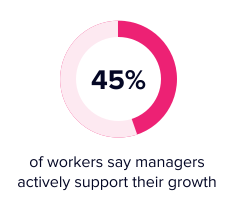
Most frontline supervisors in manufacturing were promoted because they were the best operators, not the best people leaders. This leadership gap cascades into every metric that matters: engagement, safety compliance, retention, and productivity. Only 45% of manufacturing workers say their managers actively support their growth, yet employees with effective managers are 6.3x more engaged. Structured 360 feedback designed for production environments, combined with targeted behavioral nudges, gives supervisors the specific people-leadership guidance they never received at promotion without adding administrative burden.

The Silent Turnover Risk
When Skilled Operators Leave, the Production Line Feels It Immediately
When a skilled operator leaves, the impact is immediate: missed shifts, retraining costs, safety risk from inexperienced replacements, and increased scrap. In an industry facing skilled labor shortages, turnover is especially costly. Traditional annual surveys act as post-mortems, explaining why people left months after the damage is done. Continuous pulse listening identifies burnout and friction at the shift or line level before resignation occurs. Lifecycle listening at onboarding, 90-day checkpoints, and exit surfaces early warning signals, enabling intervention while retention is still possible.

The Safety-Engagement Link
Safety Culture Is Built on Employee Engagement, Not Compliance
Disengagement and safety incidents are closely linked. Workers who feel unheard are less likely to report near-misses, follow ergonomics protocols, or raise safety concerns early. Treating employee feedback as a leading indicator of safety performance allows leaders to intervene before disengagement results in injury. By capturing safety sentiment alongside operational feedback, organizations connect perception data to incident rates — and hold leaders accountable for the cultural conditions that precede accidents.

The Listening Access Gap
If Your Strategy Relies on Email, You're Missing 80% of Your Workforce
Manufacturing's deskless majority lacks corporate email, dedicated workstations, and often reliable internet access during shifts. Silence from the floor reflects a lack of access, not satisfaction. Multi-channel feedback through QR codes, text-based surveys, tablet kiosks at shift change, and multilingual/voice-enabled options ensures the people closest to production have the same voice as corporate office employees. Organizations that bridge this access gap discover insights about scheduling, safety, equipment, and work conditions that never surface through traditional channels.

Science-Backed: People Insights Model
Manufacturing employee experience requires measurement designed for frontline realities. The People Insights Model provides a science-backed framework connecting employee feedback to the behaviors that drive safety, retention, and operational performance. Built from analysis of more than 20 million employee survey responses, the model identifies 10 core factors and 40 underlying themes that predict outcomes manufacturing leaders care about.
Learn Moreabout the People Insights Model
Common Questions About Manufacturing Employee Experience
Manufacturing employee experience encompasses the interactions, perceptions, and feelings workers have throughout their employment in production environments. This includes everything from onboarding and daily work conditions to relationships with supervisors, opportunities for advancement, and how safely and respectfully workers feel treated.
Unlike office-based employee experience, manufacturing EX must account for deskless work environments where most workers lack personal computers or company email access. Shift-based schedules create communication and survey timing challenges. Physical work conditions, including safety, ergonomics, and facility environment, directly affect daily perceptions. Supervisors often manage large teams across multiple shifts with limited one-on-one interaction time. And many manufacturing sites include union representation that shapes how feedback is gathered and acted upon.
Organizations that recognize these differences and design listening strategies accordingly see measurably better results. Keurig Dr Pepper, with 20,000 frontline workers representing more than three-quarters of its workforce, built its entire employee listening program around reaching workers in manufacturing, supply chain, and distribution roles through channels that accommodate their work reality.
Manufacturing presents distinct challenges that require specialized approaches to employee listening and action. The fundamental differences include:
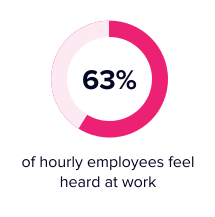
Deskless majority: Roughly 80% of workers don't sit at a desk or have regular computer access. Traditional email-based surveys miss the people closest to production, quality, and safety outcomes. Research shows only 63% of hourly employees feel heard by their organizations, often because of technological barriers that prevent survey participation.
Shift-based operations: Rotating shifts create logistical complexity for communication and feedback collection. Survey timing must accommodate workers who may not be on-site when headquarters sends an invitation. Coca-Cola Consolidated addressed this by using multiple communication tools including banners, vinyl displays, and digital screens at all locations to ensure accessibility regardless of shift schedule.
Physical work environment: Safety, ergonomics, equipment quality, and facility conditions shape daily experience in ways that don't apply to knowledge workers. Workers experiencing substandard physical conditions often disengage before they vocalize concerns.
The "accidental manager" phenomenon: Most frontline supervisors were promoted for technical excellence, not people management skills. This leadership gap between technical expertise and communication ability affects every aspect of the employee experience and is why DuPont used 360 assessments specifically designed for production managers, resulting in +7 points improvement in career conversations and +5 points in performance feedback.
Employee experience directly connects to the operational metrics manufacturing leaders track daily. The connection is mathematical, not theoretical.
Retention and turnover costs: Engaged manufacturing workers are more likely to stay. Replacing skilled operators and technicians creates hiring costs, training time, productivity gaps, and institutional knowledge loss. With 78% of manufacturers reporting 10%+ voluntary turnover among hourly workers, even small improvements in retention translate to significant savings.
Safety performance: There is a direct correlation between disengagement and safety incidents. Workers who feel unheard are less likely to report near-misses or follow protocols. Perceptyx research found that safety culture scores are 7 percentage points lower among hourly workers compared to salaried employees, indicating a perception gap that creates risk. Treating employee feedback as a leading safety indicator allows intervention before incidents occur.
Productivity and quality: Engaged frontline workers contribute improvement ideas, catch defects earlier, and maintain consistent output. The discretionary effort that defines world-class plants requires workers who choose to give 100% because they believe leadership is listening. Perceptyx benchmark data shows manufacturing workers now report authority to make decisions at 2 percentage points above benchmark averages, indicating room for further gains.
Talent attraction: Reputation spreads quickly in manufacturing communities. Organizations known for positive working conditions recruit more easily in tight labor markets competing with warehousing, logistics, and gig economy alternatives. Perceptyx benchmark data reveals an advocacy gap: while 82% of manufacturing employees are proud to work for their company, only 74% would recommend it as a great place to work. Closing that gap matters in an industry facing ongoing labor shortages and competition for skilled talent.
Listening data from manufacturing workforces reveals consistent themes about what drives engagement and retention at the frontline level.
A voice in decisions that affect their work: Workers want input on processes, schedules, and workplace changes. Feeling ignored erodes trust quickly. At Keurig Dr Pepper, frontline team members provided feedback that led to tangible changes like mother's rooms and scheduling flexibility: "There are so many examples from female frontline team members who said, 'Hey, it'd be great to have a mother's room'... and we could get those ideas implemented."
Respect and recognition from supervisors: Day-to-day interactions with frontline leaders shape experience more than company-wide programs. Acknowledgment of hard work matters. Research shows only 69% of employees agree they receive recognition for their accomplishments, representing a gap that meaningful, supervisor-delivered recognition can close.
Clear communication about company direction: Manufacturing workers often feel disconnected from leadership and strategic decisions. Transparency about business health and direction builds commitment. Inari overhauled its communication protocols after employee feedback revealed a desire for more focused discussions on business themes and a faster meeting pace, leading to what their CEO called "the best meeting we've had."
Opportunities for growth and advancement: Career paths in manufacturing are not always visible to frontline workers. They want skill development and promotion opportunities. Perceptyx benchmark data shows that while 79% of manufacturing employees believe their roles make good use of their skills, only 63% see clear career opportunities and just 59% believe advancement is handled fairly. DuPont saw notable increases in production managers holding career conversations after implementing targeted 360 feedback and development programs.
Safe and supportive work conditions: Beyond compliance, workers want to feel the company genuinely prioritizes their wellbeing, including physical safety, mental health, and work-life balance. Emerson responded to employee feedback by creating a comprehensive well-being strategy across physical, mental, financial, and social health pillars, driving their well-being index from 71% to 83% in one year.
Traditional annual surveys miss much of the manufacturing workforce. Effective listening requires meeting workers where they are through multiple channels adapted for shift-based, deskless realities.
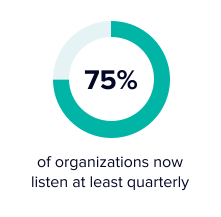
Pulse surveys adapted for shift schedules: Short, frequent surveys timed around shift changes enable participation without disrupting production. Brief completion times of 3-5 minutes accommodate breaks or pre/post-shift moments. Perceptyx research shows 75% of organizations now listen to employees at least quarterly, compared to just 18% surveying more than once per year a decade ago.
Kiosk and mobile feedback channels: Physical kiosks in break rooms, QR codes posted in common areas, and mobile-friendly surveys reach workers without corporate email. The key is simplicity combined with anonymity. One customer successfully reached frontline employees who lack work-issued laptops by offering surveys via three means simultaneously: email for those with access, text messages, and QR codes throughout properties.
Manager-led listening conversations: Train frontline leaders to hold regular check-ins and team discussions. Structured questions yield consistent insights while building trust. Eaton sets clear expectations that all managers hold survey feedback meetings with their teams and involve employees in the action planning process.
Onboarding and exit feedback loops: Capture experience at key transitions. New hire feedback reveals early friction that predicts turnover. Exit feedback identifies preventable causes while there may still be time to intervene. Lifecycle surveys that connect directly to HRIS systems ensure the right person receives the right survey at the right time.
Frontline supervisors and team leads are the primary touchpoint for manufacturing workers. Their skills determine experience quality more than any corporate program or policy.
The challenge is that most manufacturing supervisors were promoted for technical excellence, not people management ability. They know how to run a line but may not know how to hold a developmental conversation, recognize signs of burnout, or translate company strategy for their teams. Research shows employees who evaluate their manager as ineffective are more than 6x as likely to report they will leave within a year compared to those with effective managers.
Key skills frontline leaders need include:
- Communication: Translating company messages downward and gathering feedback upward
- Recognition: Acknowledging contributions in ways that feel genuine to frontline workers
- Coaching: Developing team members and addressing performance conversations
- Digital literacy: Using technology tools for scheduling, feedback review, and action planning
DuPont addressed the production manager development gap through 360 feedback assessments with continuous access and monthly administration. Production managers showed significant improvement: +7 points in career conversations, +5 points in performance feedback, and +5 points in work-life balance support. Their manufacturing sites saw an 80% engagement index score with only 5% voluntary attrition.
The data is clear: investing in frontline leader development has an outsized impact on manufacturing employee experience. Organizations can assess manager effectiveness through employee feedback, then deliver personalized development through AI-powered coaching and behavioral nudges embedded in daily workflows.
Listening without action damages trust. Workers become cynical when feedback disappears into a reporting void. The gap between insight and impact is where most engagement programs fail.
Perceptyx benchmark data quantifies this challenge: while 75% of manufacturing employees feel encouraged to improve how work is done, only 58% believe change is handled effectively overall. And while 73% feel personally supported in adapting to change, just 60% believe the organization consistently seeks employee input before decisions are made. Manufacturing organizations are good at expecting adaptability but less consistent at designing change in partnership with the people closest to the work.
Identify high-impact focus areas from feedback data: Analyze survey results to find themes with the greatest influence on engagement and retention. Prioritize issues within organizational control. Agentic AI can surface these patterns automatically, showing managers exactly where to focus rather than overwhelming them with data.
Engage frontline leaders in action planning: Involve supervisors in developing solutions. They understand local context and can champion changes with their teams. The 1-2-3 approach, proven across Perceptyx's customer base, simplifies this: select 1 focus area, do 2 things about it, and check back in 3 months. Coca-Cola Consolidated achieved an 81% participation rate by engaging frontline managers as drivers of the survey process.
Communicate findings and commitments to workers: Share what was heard and what will be done. Even when not all issues can be addressed, acknowledgment matters. Use shift meetings, posters, digital displays, and whatever channels reach your workforce. Inari shares "Survey in Action" success stories via intranet and TV screens at key locations to maintain visibility of positive changes.
Track progress and adjust based on ongoing feedback: Follow up with pulse surveys to measure whether actions are working. Continuous listening reveals impact and allows course correction. Solenis monitored and tracked action plan implementation through the platform, achieving a participation increase from 87% to 89% even while integrating 9,000 new employees from an acquisition.
Measurement enables accountability and demonstrates ROI. The most effective approach combines perception data from surveys with operational data for a complete picture.
Engagement and sentiment scores: Track overall engagement index and specific driver scores from surveys. Monitor trends over time and compare across sites, shifts, and teams. Manufacturing-specific benchmarks from the Perceptyx database allow comparison against industry peers.
Retention and turnover metrics: Track voluntary turnover rates, especially for high performers and hard-to-fill roles. Early turnover (first-year departures) signals onboarding issues. Connect listening data to turnover outcomes to identify leading indicators. Predictive analytics can flag at-risk employees before they resign.
Safety and absenteeism indicators: Incident rates, near-miss reports, and unplanned absences correlate with engagement. Safety culture surveys reveal whether workers feel psychologically safe reporting concerns. Improvement in these metrics validates experience investments.
Manager effectiveness ratings: Track employee ratings of supervisor support, communication, and fairness. This identifies leaders who need development and those whose practices should be replicated. Perceptyx benchmark data reveals a 7-point gap in decision-making authority between salaried (80%) and hourly (73%) workers, suggesting manager empowerment of frontline employees remains an opportunity area.
Manufacturing turnover requires targeted interventions informed by listening data rather than generic retention programs. The drivers of turnover differ by role, tenure, and location.
Catch the "silent exit" before it happens: Traditional annual surveys are post-mortems that tell you why people already left. Continuous listening through pulse surveys and lifecycle touchpoints identifies burnout and friction on specific shifts or lines before they translate to resignations.
Invest in frontline manager capability: The relationship with an immediate supervisor is the strongest predictor of whether manufacturing workers stay or leave. Yet most supervisors lack people management training. DuPont maintained 5% voluntary attrition by systematically developing production managers through 360 feedback, resulting in measurable improvements in the behaviors that drive retention.
Act visibly on feedback: Workers who see their input leading to tangible changes develop commitment. Workers whose feedback disappears lose trust and eventually stop engaging. Keurig Dr Pepper built retention by implementing frontline suggestions ranging from mother's rooms to scheduling flexibility, demonstrating that leadership listens.
Address physical conditions and safety: Workers experiencing substandard facilities, equipment, or safety practices disengage before they vocalize concerns. Use safety culture surveys to identify perception gaps before they drive turnover.
Safety and engagement are not separate programs. They are interdependent systems where improvement in one drives improvement in the other.
Disengaged workers are less likely to report near-misses, follow protocols, or speak up about hazards. When workers feel unheard, they protect themselves by staying silent. Research shows that employees who feel supported by their managers in health decisions are almost twice as likely to believe senior leadership is effectively leading through challenges.
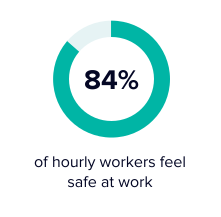
The perception gap matters: salaried workers report safety perceptions 7 percentage points higher than hourly workers (91% vs. 84%). This gap indicates that frontline workers closest to physical hazards may feel less psychologically safe raising concerns.
Effective approaches treat employee feedback as a leading indicator of safety rather than relying solely on lagging indicators like incident rates. Organizations can:
- Use safety culture surveys to identify psychological safety gaps before they become incidents
- Create anonymous reporting mechanisms that protect workers who raise concerns
- Train managers to treat safety discussions as ongoing conversations, not annual events
- Recognize learning and improvement rather than celebrating incident-free streaks that may drive problems underground
Engagement drivers differ between salaried and hourly workers, requiring tailored listening and action strategies.
Perceptyx benchmark data reveals that manufacturing employees remain committed: 82% are proud to work for their company, 83% intend to stay for at least the next 12 months, and 79% report a sense of personal accomplishment from their work. However, advocacy lags at 74%, signaling that while employees are committed, they are not uniformly confident the experience is improving at the same pace as operational demands.
Additional research reveals important gaps in performance enablement between salaried and hourly populations:
- Decision-making authority: 80% of salaried employees say they have authority to make decisions necessary to do their job, compared to just 73% of hourly employees
- Engagement overall: 82% of salaried workers report engagement compared to 78% of hourly workers
- Safety perceptions: Salaried workers report 7 percentage points higher than hourly on safety
These gaps suggest that frontline workers face limitations in acting independently, which slows execution and reduces accountability. Bridging them requires:
Voice and influence: Hourly workers want input on processes, schedules, and changes that affect their daily work. Crowdsourcing and suggestion mechanisms that visibly lead to implementation build commitment.
Supervisor relationship quality: For hourly workers, the immediate supervisor is the primary connection to the organization. Manager effectiveness programs that develop communication and recognition skills have outsized impact.
Accessible feedback channels: Workers without email need alternative paths to share concerns and ideas. Multi-channel delivery via kiosks, QR codes, SMS, and mobile ensures every voice can be heard.
Visible action: Hourly workers are often skeptical that their input matters. Organizations that close the loop by communicating "you said, we did" build trust over time.
Manufacturing surveys require design choices that differ fundamentally from office worker surveys.
Length and format: Keep surveys brief enough to complete during a break or shift change. Research shows that frontline surveys work best at 15-20 questions taking 5-7 minutes. Mobile-friendly formats with large buttons and simple navigation accommodate workers who rarely interact with technology.
Delivery channels: Mixed-access methodology reaches every worker regardless of their technology situation. Successful organizations offer surveys via email, SMS, QR codes, and kiosks simultaneously. Physical infrastructure like break room kiosks and posted QR codes provide access without requiring personal devices.
Timing: Accommodate shift schedules rather than assuming 9-to-5 availability. Survey invitations should reach workers when they can respond. Protected time for survey completion signals organizational commitment to hearing feedback.
Language: Multilingual surveys in workers' preferred languages increase participation and accuracy. Perceptyx’s platform, for example, supports 34 languages built-in with up to 140 available, ensuring accessibility across diverse manufacturing workforces.
Content: Include manufacturing-specific items about safety, physical conditions, equipment, scheduling, and frontline leader relationships. Generic engagement surveys miss the issues that matter most to production workers.
Developing frontline leaders requires approaches designed for their reality, not repurposed corporate leadership programs.
Most manufacturing supervisors became leaders because they were the best operators on their line. They know the technical work inside and out. What they often lack is training in the people management skills that now determine whether their teams stay, engage, and perform safely. Research confirms that employees with ineffective managers are more than 6x as likely to leave within a year.
The stakes are high: Perceptyx research shows that frontline employees who receive the right training are 6.3x more likely to be fully engaged. Yet only 45% of frontline workers say their managers actively support their growth, creating a significant opportunity to strengthen development infrastructure.
Effective development programs for frontline manufacturing leaders include:
360 feedback designed for production environments: DuPont implemented three distinct 360 feedback assessments through continuous access with monthly administration. Production managers showed +7 points in career conversations, +5 points in performance feedback, and +5 points in work-life balance support.
Behavioral nudges in the flow of work: Rather than pulling supervisors off the floor for training, deliver science-backed suggestions through Teams, Slack, email, or whatever channel reaches them. This approach yields 83% manager engagement with nudges at least weekly and up to 12-point increases in engagement scores.
Manager effectiveness measurement: Track employee ratings of supervisor support, communication, and fairness through surveys. Identify leaders who need development and those whose practices should be replicated.
Action planning support: Give supervisors the 1-2-3 action planning framework used by Coca-Cola Consolidated and others: select 1 focus area, do 2 things about it, check back in 3 months. AI-powered recommendations provide concrete suggestions without adding burden.
Continuous listening replaces periodic surveys with ongoing feedback collection across multiple channels, enabling faster response to changing conditions.
Annual surveys alone cannot capture the dynamic nature of frontline work. Issues emerge between survey cycles. Worker sentiment shifts with production demands, personnel changes, and market conditions. Perceptyx research shows that employees who feel a strong sense of belonging are 2.4x as likely to feel supported in adapting to change, demonstrating that trust and inclusion serve as foundations for transformation readiness. Organizations seeing the best results combine multiple listening approaches:
Annual census surveys provide comprehensive baseline measurement and enable year-over-year tracking across all sites and populations.
Quarterly or monthly pulse surveys check sentiment on specific issues without the burden of full-length surveys. Perceptyx data shows 75% of organizations now listen at least quarterly.
Lifecycle surveys at onboarding, promotion, and exit capture experience at transition points that predict engagement and retention. Integration with HRIS ensures surveys reach the right person at the right time.
Always-on channels like kiosks and suggestion mechanisms provide ongoing input without waiting for scheduled surveys.
Manager conversations structured around consistent questions yield qualitative insights that complement quantitative survey data.
For manufacturing specifically, this multi-channel approach must accommodate shift schedules, deskless workers, and multilingual populations. Solenis demonstrated the power of continuous listening during a major acquisition, successfully surveying 9,000 new employees while maintaining 89% participation through a streamlined process with manager action planning.
Demonstrating ROI requires connecting employee experience metrics to operational and financial outcomes that manufacturing leaders already track.
Turnover cost calculation: Calculate the full cost of replacing a manufacturing worker, including recruiting, hiring, onboarding, training, and productivity loss during ramp-up. Then track how experience improvements affect voluntary turnover rates. Even small percentage improvements yield significant savings when turnover costs range from 50-200% of annual compensation.
Safety incident correlation: Map engagement and safety culture scores against OSHA recordables, near-misses, and workers' compensation claims. Organizations with higher engagement consistently show better safety performance.
Productivity metrics: Track quality metrics, scrap rates, and production efficiency alongside engagement scores. Teams with higher engagement demonstrate better performance on these operational measures.
Predictive value: Use analytics to identify leading indicators of turnover, safety incidents, and performance problems before they occur.
Real customer examples provide concrete ROI evidence:
- Emerson: 12% increase in well-being index in one year through employee feedback-driven strategy
- DuPont: Only 5% voluntary attrition with 80% engagement index through production manager development
- Keurig Dr Pepper: 4.2% improvement in leadership metrics pushing manufacturing sites 10% above other locations
AI transforms manufacturing employee experience by bridging the gap between collecting feedback and driving action at scale.
Text and sentiment analysis: Manufacturing workers often share nuanced feedback in open-text comments that manual review cannot process at scale. Agentic AI identifies themes and sentiment across thousands of comments, surfacing issues that closed-ended questions miss.
Automated action planning: Traditional post-survey action planning requires managers to interpret reports, connect insights to goals, and manually build improvement plans. Most never complete this work. AI-assisted action planning automatically generates tailored recommendations based on each team's unique data, engaging the entire workforce in improvement rather than just the 20% of managers who were already good at it.
Behavioral nudges: Science-backed, personalized suggestions delivered through Teams, Slack, email, or other channels guide specific behaviors that improve engagement. Research shows 83% of managers engage with nudges at least weekly, with teams receiving targeted nudges achieving up to 12-point increases in engagement scores.
Predictive analytics: AI identifies patterns that predict turnover, safety incidents, and disengagement before they occur. This shifts organizations from reactive problem-solving to proactive intervention.
For manufacturing specifically, AI enables scale without adding burden to frontline supervisors who already manage large teams across multiple shifts. The supervisor who was promoted for technical skills receives the "operating manual" for their people that they never received during onboarding.
Both union and non-union manufacturing environments benefit from employee listening, though implementation details may vary based on collective bargaining agreements and labor relations dynamics.
Research shows that employee engagement serves as common ground for union and non-union workers. Both populations want voice in workplace decisions, respect from supervisors, safe working conditions, and opportunities for growth.
Key considerations for union environments:
Transparency with labor leadership: Engage union representatives early in survey design and communication planning. Demonstrate that listening programs complement rather than circumvent collective voice mechanisms.
Anonymity protection: Ensure survey confidentiality standards meet or exceed any contractual requirements. Workers must trust that individual responses cannot be identified.
Focus on actionable items: Concentrate on experience elements within management control rather than items that require collective bargaining changes.
Shared communication: Coordinate messaging about survey purposes and results with union communication channels.
Manufacturing organizations with mixed union and non-union populations can benchmark engagement across both groups to identify common opportunities and location-specific needs. The goal is understanding worker experience to improve conditions, not circumventing collective representation.
Start with listening. Before launching programs or making assumptions about what workers need, collect feedback through channels that actually reach your frontline population.
Assess your current listening maturity: Do you know what your manufacturing workers experience daily? Can you compare engagement across shifts, sites, and populations? Do frontline supervisors have data on their teams' sentiment? An assessment from a listening partner like Perceptyx can help identify gaps.
Design for deskless access: If your current survey relies on email, you're missing 80% of the conversation. Evaluate multi-channel options including kiosks, QR codes, SMS, and mobile that meet workers where they are.
Involve frontline leaders: Supervisors must champion listening efforts and own action planning. Communicate why feedback matters and how it will translate to improvement.
Commit to visible action: The worst outcome is surveying workers and then failing to respond. Plan the action cycle before you launch the survey.
Organizations starting their manufacturing employee experience journey can learn from those further along. Inari launched a comprehensive listening program that quickly grew a culture of continuous improvement. Solenis successfully integrated 9,000 new employees through employee listening during an acquisition. Emerson created a comprehensive well-being strategy from employee feedback that drove measurable results.
A common thread runs through all of this: start by listening, then act visibly on what you hear.
Transform Your Retail Employee Experience Today
Join the ranks of the world’s leading organizations leveraging Perceptyx to foster a culture of continuous, positive change.