Employee experience solutions that turn feedback into business results
Perceptyx connects every listening channel to manager action and proof of impact in one platform, turning employee experience into measurable retention and performance gains.
Trusted by the Fortune 1000
Customer Impact Stories:
- 7% reduction in first-year turnover
- $2m saved in hiring costs
- 2.6% lift in Custom Service Index
- 96% survey response rate achieved
- 2.8pt increase in guest experience scores
- 60% team member engagement on social initiatives
- 4.2% improvement in frontline leadership metrics
- 91% frontline response rate
- 17 of 20 people manager metrics improved
Why Most Employee Experience Programs Produce Data Without Results
Most organizations measure employee experience and still can't tie it to business performance. These six patterns are often why that happens.
The Wrong Diagnosis
Retention Spending Lands on the Wrong Problems
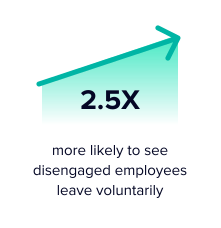
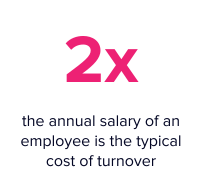
Turnover gets managed as a pay and benefits problem when the experience driving those exits, from manager quality to workload to stalled growth, is what actually needs diagnosing. Retention budgets fund fixes for causes that were never the issue and the departures continue. Connecting exit and lifecycle signals to the experience factors that statistically predict turnover points spending toward what actually changes the outcome.

The Single-Metric Trap
One Engagement Score Becomes the Whole Program
Engagement is a single number sitting on top of a much larger system of drivers, from onboarding and manager quality to growth and workload. When a program optimizes for that one score, the factors that actually move it go unmanaged and the number plateaus. Measuring the full employee experience, and tying each driver to the outcome it affects, gives leaders something to manage past a headline metric.

Cost Center Thinking
Employee Experience Keeps Getting Funded Like a Cost Center
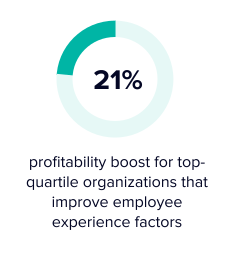
When experience data never connects to retention, productivity, and revenue, leadership treats it as a cost to control instead of a growth lever — stalling the business case along with the funding. Tying experience metrics to the financial outcomes they influence turns the budget conversation into a growth case. The same numbers that justify the program also show where to expand it.

Solving the Wrong Problem
Conflating Experience and Engagement Builds Programs Around the Wrong Cause
Teams that treat experience and engagement as the same thing design around a symptom, launching a perks program when the real issue is manager capability, or a recognition push when the problem is workload. The tactics miss, and neither the score nor the underlying experience improves. Separating the outcome from the drivers that move it lets program design target the actual cause.

Scattered Signals
Experience Data Exists Everywhere and Consolidates Nowhere
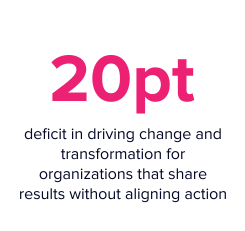
Signals about the experience live across onboarding, pulse, exit, 360, and everyday conversation, but they never assemble into a picture leaders can act on strategically. Each source tells a fragment while the organization-level story stays out of reach. Bringing every channel onto one analytics layer turns scattered inputs into a coherent view of where experience is helping or hurting the business.

The Delayed Alarm
Experience Problems Stay Invisible Until They Reach the Financials
Experience deterioration rarely announces itself. It surfaces later as turnover cost, lost productivity, and culture damage that are already compounding by the time they show up in a financial report. Continuous listening tied to business metrics catches the decline while it is still a leading indicator, before it becomes a lagging cost.

Science-Backed Differentiator: People Insights Model
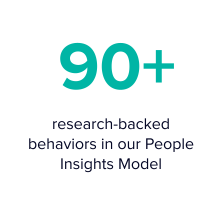
Plenty of platforms produce an experience score. The People Insights Model goes further. The scientific backbone underneath the Perceptyx People Activation System, it is built on behavioral science and 20+ years of benchmarked responses. It isolates the drivers that statistically predict productivity, retention, and performance, factors like purpose, growth, manager support, recognition, and well-being, and ties each one to the business outcome it moves.
Those drivers feed one connected system. Perceptyx AI Agents read open-text feedback at scale and deliver each manager a short, prioritized list of actions within days of survey close. The Conversational Listening Agent captures more authentic insights that traditional surveys miss, while the Narrative Analysis Agent turns thousands of comments into themes, sentiments, and priorities. Annual surveys, lifecycle surveys, pulse checks, crowdsourcing, and 360 feedback all run on the same analytics layer, turning workforce insights into personalized AI coaching and intelligent nudges delivered where employees already work.
Our Workforce Transformation Consultants add the human layer. They are practitioners who run listening programs inside large, complex organizations, working alongside HR to design survey architecture, interpret results in context, build executive presentations, and facilitate action planning at scale. That kind of partnership keeps a CHRO from being left alone with a dashboard, and ensures that every listening moment leads to provable business impact.
Learn Moreabout the People Insights ModelCommon Questions About Employee Experience
Employee experience is the full set of perceptions, interactions, systems, and emotions that shape an employee's working life, from the first interview to the last day. Engagement sits inside that larger frame as one outcome among many, which is part of what separates the two. Measuring all of it, rather than engagement alone, is what tells you why people stay, leave, thrive, or struggle.
Engagement is a psychological outcome: how committed and motivated people feel. Employee experience is the entire journey that produces that outcome, including manager quality, resources, growth, and belonging. Improving the experience first creates the conditions for engagement to rise, which is why experience is the more useful lens for action.
Employee experience shapes retention, productivity, customer loyalty, and safety. In Perceptyx data, highly engaged employees are 84% less likely to be job-seeking, 3x more likely to report year-over-year productivity gains, and 9x more likely to be satisfied with the company overall. A poor experience does the reverse, and the latest workforce data shows the divide between strong and weak programs widening.
Measure it across multiple listening channels working together: census surveys for the organizational snapshot, pulse checks for targeted moments, and lifecycle surveys for onboarding, transitions, and exit. Segmenting results by role, team, and location is what turns a raw score into something you can act on, and leading indicators like autonomy and trust in leadership tend to move before engagement does.
Start by acting on what you hear; employees re-engage when they see feedback produce change. The biggest lever is your managers, who have the largest single influence on day-to-day experience, so give them team-level data plus specific next steps. Choose one priority, identify a couple of actions, and communicate progress more than once.
Cadence should match your capacity to act. About 75% of organizations now listen at least quarterly, combining an annual or semi-annual census with shorter, targeted pulse surveys and event-triggered lifecycle surveys. More frequent listening without follow-up backfires, so frequency should never outrun action.
The thing usually called survey fatigue is lack-of-action fatigue. Employees respond when they believe input will be heard and acted on. One Perceptyx client surveyed essential workers, made changes within days, and saw the response rate climb on the next survey three weeks later. Visible action fixes it; a shorter survey does not.
For HR, employee experience is the shift from administering processes to designing experiences across the lifecycle. It also carries a cost: more than 4 in 10 HR leaders say their jobs have grown more stressful, and a listening strategy that turns data into action takes work off overstretched teams rather than adding to it.
Listen at the moments that compound over time: candidate, onboarding, role and manager changes, anniversaries, and exit. Linking these moments, for example connecting onboarding responses to later engagement and exit data, shows which early experiences predict who stays.
Onboarding is the first test of whether the organization delivers on its recruiting promises. Only 29% of new hires feel fully prepared and supported, so measure the experience at multiple stages, around 2 to 4 weeks, 3 months, and 6 months, and connect it to retention rather than checklist logistics.
Look for continuous, multi-channel listening that goes beyond an annual survey: census, pulse, lifecycle, 360, crowdsourcing, and conversational listening in one place. Add analytics that find drivers and predict risk, and an action layer that routes specific recommendations to managers.
The best employee experience management software connects listening to action by consolidating feedback channels, surfacing priorities automatically, and routing insights to the managers who own them. This ensures that the gap between data and measurable change actually closes.
Perceptyx was named a Leader in the 2025 Forrester Wave for EX platforms. Where other Leaders diversify across customer experience, patient experience, or market research, Perceptyx is dedicated to employee experience, and the AI is trained on employee and leadership behavior to recommend the specific next action a manager's team needs.
Real-time dashboards show engagement trends, driver analysis, and predictive indicators at the organization, team, and manager level, with comment analytics that surface themes and sentiment at scale. Managers get personalized views with benchmarks and recommended actions; leaders get organization-wide views with drill-down.
Returns show up in lower turnover and the recruitment and training costs that come with it, in productivity gains, and in customer-satisfaction improvement. A major restaurant chain found that each one-point rise in engagement corresponded to better call resolution and customer satisfaction, and connecting experience data to business metrics is how you prove that link to a CFO.
Run one program across regions with multi-language delivery, local benchmarks, and core questions that stay comparable while regional teams add locally relevant items. Engagement varies widely by region, so interpreting scores in local context, rather than ranking countries against each other, leads to better action plans.
A reminder tells someone to do something; a nudge tells them what to do, why it matters for their situation, and how to do it in the next 30 seconds. Each standard nudge is generated from listening data, mapped to one of 90 behaviors in the People Insights Model, and drawn from a science-backed library of roughly 3,500 nudges delivered in the tools people already use.
Perceptyx research combines surveys, focus groups, journey mapping, and behavioral analysis, run by an in-house team of I/O psychologists and behavioral scientists. Through Workforce Transformation Consulting, the team publishes original research and benchmarks from more than 20 million responses to guide where and when to act.
Measurement shows where the experience is strong or weak; it does not change anything on its own. Improvement comes from acting on what the data says, reinforcing the new behavior, and confirming it held. Organizations that close that loop, rather than stopping at the report, are the ones whose scores actually move over time.
The data has to reach the manager who owns each team, in a form they can act on, while it is still current. That means translating priorities into a few specific actions, assigning ownership, and tracking follow-through, instead of handing managers a raw dashboard and hoping.
Improving employee experience at scale means thousands of managers and employees adjusting how they work, receiving development and validation of their comprehension, and finally being reinforced until the new behavior becomes routine. That is behavior change at scale, and it is what links a listening program to a measurable shift in retention and performance rather than a one-time score bump.
Some experience gaps are about how people feel; others are about what they can do. Listening surfaces the capability gaps, and development that reinforces real skills, rather than tracking course completions, is what closes them. The same listening that improves experience can point development to where it will matter most.
Most of the workforce does not sit at a desk, and traditional email surveys miss them. Reaching frontline and deskless employees means meeting them where they are, through mobile, SMS, kiosks, QR codes, Slack, and Teams, in the languages they actually speak.
Not every issue deserves equal attention. Rank them by predicted impact on the outcomes you care about, like retention and productivity, then start where the evidence is strongest and the effort is reasonable. Acting on a few high-impact priorities beats spreading thin across every data point.
Yes, but this only works when the personalization runs on the organization's own feedback data instead of a generic content library. In the case of Perceptyx’s People Activation System, a manager whose team flagged unclear priorities receives coaching and weekly nudges on that behavior, while the manager down the hall with a psychological safety gap receives a different set entirely. All of this is mapped to the People Insights Model behaviors that predict outcomes for that team. Effectiveness is measurable at the team level, where the test is whether the items being coached improve on the next survey. Data governance shouldn’t be overlooked, either. Perceptyx keeps comment analysis aggregated and depersonalized, with guardrails that block questions about individual employees or advice on employment decisions.
Ready to Build an Engagement Program That Drives Business Outcomes?
Plenty of organizations run engagement surveys, but the value only shows up when those surveys connect to manager action and improvement you can measure over time. A conversation with our team starts with your current program, what's working in it, and where the biggest opportunities for improvement remain.