Your Complete Healthcare Employee Experience Solution
The prescription for patient experience is employee experience powered by listening that connects workforce engagement to patient outcomes.
Trusted by leading healthcare organizations






Customer Impact Stories:


The Burnout Crisis
Staffing Shortages and Clinician Burnout Are Eroding Patient Care
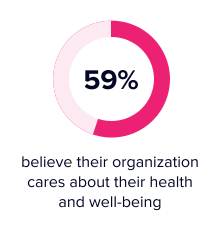
Burnout affects one in three nurses, workplace violence incidents have increased 249% since 2019, and the cost of replacing a single registered nurse averages $61,110. Perceptyx data reveals why the problem persists: only 59% of clinical employees believe their organization cares about their health and well-being, compared to 70% of non-clinical staff. The people closest to patients feel the least supported by the system built around them. Continuous pulse listening identifies units, shifts, and roles where burnout, workload strain, and safety concerns are escalating before they result in resignations or adverse patient events.

The EX-PX Connection
Employee Experience Improvements Drive Patient Experience Gains
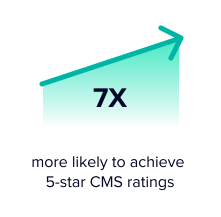
Hospitals in the top quartile for employee engagement are 7x more likely to achieve 5-star CMS ratings than those in the bottom quartile. The correlation is direct: engaged clinicians communicate better with patients, follow safety protocols more consistently, and create the care continuity that drives HCAHPS star ratings and Medicare reimbursement. Yet employee experience too often takes a backseat to initiatives that exacerbate the issues faced by frontline clinicians. Cross-survey, dashboard-visualized analytics that integrate workforce feedback with patient satisfaction data, quality metrics, and operational outcomes can reveal which experience drivers produce the greatest downstream impact on the metrics that matter to patients, stakeholders, and regulators.

The Leadership Gap
Nurse Managers Lack the Development Critical to High-Stress Roles
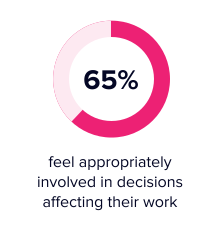
Nurse managers and charge nurses operate as the link between organizational strategy and bedside care, yet most receive minimal leadership development before or after promotion. Healthcare benchmark data quantifies the gap: recognition sits at just 65% among nurses, and only 61% feel appropriately involved in decisions affecting their work, nearly 10 points below non-clinical peers. Structured 360 feedback designed for clinical leadership roles identifies where managers need targeted development in communication, recognition, and team support. A feedback loop of assess → develop → re-survey creates measurable accountability for leader improvement, with returns across engagement, retention, and patient satisfaction at the unit level.

The Listening Gap
Annual Surveys Miss the Realities of a 24/7, Shift-Based Workforce
Healthcare workers operate across three shifts, multiple campuses, and roles ranging from bedside clinicians to support staff to administrators. Traditional annual engagement surveys reach desk-based employees reliably but miss the deskless majority who deliver direct patient care. Multi-channel listening strategies combining mobile-first surveys, QR codes in break rooms, and text-based delivery capture input from all workforce segments regardless of email access or shift schedule. Lifecycle listening at onboarding, 90-day checkpoints, tenure milestones, and exit ensures organizations hear from the people closest to patients throughout their entire employment journey.

Science-Backed: People Insights Model
Perceptyx's People Insights Model provides the scientific backbone for transformative listening strategies in healthcare. Built on rigorous behavioral science research and benchmarked across millions of respondents, including role-specific benchmarks for nurses, physicians, and support staff, the model connects employee feedback directly to behaviors that drive patient outcomes.
Learn Moreabout the People Insights Model
Common Questions About Healthcare Employee Experience
Healthcare employee experience encompasses every interaction, perception, and feeling employees have throughout their journey with a healthcare organization, from recruitment through daily work to exit. It includes how caregivers interact with technology, physical workspace, leadership, and organizational culture.
Employee engagement is one component within this broader experience. Engagement refers specifically to an employee's emotional commitment, motivation, and discretionary effort at a given point in time. Perceptyx research measures engagement through four components: pride in the organization, intent to stay, referral behavior (would they recommend the organization as a place to work), and intrinsic motivation.
The distinction matters for healthcare because the stakes extend beyond retention metrics. When nurses, physicians, and support staff feel supported and empowered, that experience translates directly to the quality of patient care, safety outcomes, and hospital reputation.
Perceptyx analysis of 3.85 million healthcare workers across more than 500 systems reveals several concerning trends alongside signs of progress.
The engagement gap is widening. The gulf between the most engaged healthcare organizations and the rest continues to grow, suggesting urgent action is needed by most healthcare systems. Top-performing organizations distinguish themselves through proactive approaches to change and innovation that involve and support their workforce.
Change management has emerged as a top driver of healthcare employee engagement. How leaders handle organizational change now matters more than any other factor. Organizations excelling in this area foster cultures of continuous improvement and high engagement. For the rest, improving how change is communicated and implemented represents the highest-leverage intervention available.
Investments in wellbeing are beginning to show results. After years of intensified focus on supporting employee mental and physical health, organizations are seeing positive movement in wellbeing metrics. More than 90% of healthcare workers maintain a clear understanding of their mission and how their roles contribute to organizational success, demonstrating the purpose-driven nature of the healthcare workforce.
A healthcare employee experience consortium brings together HR leaders from across health systems to share workforce strategies, benchmark results, and implementation practices. Members collaborate on common challenges including clinician burnout, retention, change management, and connecting employee feedback to patient outcomes.
Consortium participation gives organizations access to peer insights that internal teams and external consultants cannot replicate on their own. Members learn which interventions produced measurable results at similar organizations, identify emerging workforce trends before they surface in published research, and build professional networks focused specifically on healthcare employee experience.
For healthcare HR leaders interested in joining a peer community dedicated to workforce innovation and shared learning, Perceptyx’s Healthcare EX Consortium provides this type of structured collaboration.
Healthcare employee experience carries distinct characteristics that require specialized measurement and intervention approaches.
Patient care stakes. Unlike other industries, healthcare employee experience directly affects life-and-death outcomes. A disengaged nurse or physician doesn't just provide poor customer service; they may miss critical patient safety signals.
24/7 operations. Healthcare never stops, creating unique scheduling, fatigue, and work-life balance challenges. Night shifts, weekend coverage, and holiday staffing create employee experience dynamics that traditional office-based approaches cannot address.
Clinical versus non-clinical workforce dynamics. Healthcare organizations employ fundamentally different workforce segments, each with distinct professional identities, training backgrounds, and engagement drivers. Physicians, nurses, allied health professionals, and support staff all experience the organization differently and require segmented listening strategies.
Regulatory and accreditation requirements. Healthcare faces unique compliance demands around safety culture measurement, workforce satisfaction documentation, and continuous improvement that don't apply to other industries.
Moral injury and compassion fatigue. Healthcare workers face emotional demands beyond typical job stress. Perceptyx research shows that while pandemic-era teamwork strengthened relationships between managers and teams, it was tempered by reduced trust in senior leadership due to rapid changes and insufficient clarity about how changes affect frontline workers.
Perceptyx research demonstrated clear correlations between employee engagement and every major category of patient outcome.
Patient satisfaction and HCAHPS scores. Hospitals that achieved 4 or 5-star HCAHPS star ratings demonstrated engagement scores approximately 7% higher than those with 3-star ratings, and approximately 12% higher than hospitals with 1 or 2-star ratings. The relationship is even stronger for advocacy: hospitals with 4 or 5-star ratings had employee advocacy scores approximately 34% higher than hospitals with 1 or 2-star ratings.
Patient recommendations and loyalty. Employee engagement operates as the invisible force driving whether patients recommend the hospital to others. Engaged employees create experiences that generate positive word-of-mouth, online reviews, and repeat care decisions.
Clinical quality and safety metrics. A hospital's infection rate is a clinical metric. When that infection leads to readmission, it becomes an operational concern. If that patient felt unsupported or unsafe, it reflects in their HCAHPS rating. Three different metrics, three different domains, but all tied to how supported and empowered the care team felt. Perceptyx identified three primary employee experience drivers of patient experience: safety culture, recognition, and collaboration.
Hospital financial performance and turnover costs. The cost of replacing a registered nurse averages $56,300 according to industry data. Facilities with 5-star overall hospital ratings are projected to retain an additional 3% of their workforce annually compared to lower-rated facilities, translating to millions in avoided turnover costs.
Perceptyx research identified specific drivers that influence healthcare worker engagement.
Change management and organizational clarity. The approach healthcare leaders take to manage change is now the most critical driver of engagement. Employees need clarity about organizational direction, support through transitions, and confidence that leadership behaviors align with stated values. When employees don't see a clear organizational direction or feel unsupported through change, uncertainty manifests in inconsistent patient care.
Manager effectiveness and frontline support. Direct supervisors have outsized influence on engagement, especially for nurses and clinical staff. Perceptyx research shows that the pandemic actually strengthened relationships between managers and their teams. Managers who support employees through difficult situations, including challenging patient or family interactions, see higher engagement and lower turnover intent on their teams.
Workload balance and staffing adequacy. Patient-to-staff ratios, mandatory overtime, and workload directly affect burnout. Employee comments consistently cite poor staffing ratios, frequent pulls to other units, and insufficient resources as drivers of stress and disengagement.
Recognition and professional growth opportunities. Norton Healthcare found that leaders who round on staff frequently and recognize staff frequently see a 92.4% improvement in employees feeling valued. Recognition has become a leading retention strategy, with their data showing a "sweet spot" of at least eight recognition moments per year per employee.
Connection to mission and purpose. More than 90% of healthcare workers have a clear understanding of their company's mission and values. Organizations must continue reinforcing this connection because purpose remains a key element of positive worker experience. The challenge arises when rapid changes and cost pressures create distance between stated mission and daily reality.
Leaders who identify warning signs early can intervene before turnover spikes or patient care suffers.
Rising voluntary turnover rates. Tracking departures by department, unit, or role reveals where experience problems concentrate. Perceptyx analysis shows that linking exit survey data with employee perceptions captured one year prior identifies stark differences in experiences between those who stayed and those who left.
Increased absenteeism and burnout indicators. Burnout affects one in three registered nurses. Norton Healthcare developed a clear definition of burnout aligned with the World Health Organization's definition and embedded it into their measurement approach. Their data shows that frequent leader interaction and recognition led to a 42% improvement in stress and burnout scores.
Declining survey participation and engagement scores. Low response rates often signal disengagement or distrust in the feedback process. UCHealth addressed this by streamlining their survey process, seeing participation surge from 44% to 67% and confidence that feedback would drive real change increase from 47.5% to 60.5% favorable.
Negative themes in open-ended feedback. Text analytics can surface recurring concerns before they escalate. Common warning themes include lack of training, poor cross-team cooperation, work-life imbalance, and feeling that ideas are not valued.
Patient complaint and safety incident patterns. Patient experience signals often trace back to underlying employee experience issues. When employees feel unsupported, it reflects in patient perceptions of responsiveness, communication, and care quality.
Perceptyx research and customer experience point to specific investments that move engagement and retention metrics.
Continuous listening and feedback programs. The shift from annual surveys to ongoing pulse checks and lifecycle surveys allows organizations to capture feedback at moments that matter. Norton Healthcare expanded from annual surveys to include lifecycle surveys for new employees, exit surveys, topic-specific pulse surveys, and leader rounding programs. This approach allows them to adapt as quickly as conditions change for employees.
Manager development and enablement. Training and tools that help frontline managers act on feedback and support their teams generate outsized returns. Managers need practical skills for coaching, recognition, and having difficult conversations, not just operational training.
Workload and scheduling optimization. Addressing patient-to-staff ratios, reducing mandatory overtime, and creating more predictable schedules directly reduces burnout risk. Organizations must invest in staffing models that balance cost pressures with sustainable workloads.
Career pathways and professional development. Clear advancement opportunities reduce turnover, especially among nurses and allied health professionals. UW Health achieved 670 hours of nursing staff time saved while increasing engagement by 4.2% and wellbeing scores by 5.4% within one year.
Wellbeing and burnout prevention resources. Mental health support, resilience programs, and structural changes that address root causes of burnout rather than just symptoms. Hanger Inc. saw 33.5% enrollment in their Calm wellness program, a 25% increase in work-life balance scores, and 4% reduction in administrative staff attrition.
Effective measurement combines multiple approaches to create a complete picture.
Engagement surveys and pulse checks. Annual comprehensive surveys establish baseline metrics, while shorter, more frequent pulse surveys track changes and measure the impact of specific interventions. UCHealth reduced their survey from 45 questions to six highly actionable items and now surveys employees three times per year.
Employee Net Promoter Score (eNPS) benchmarks. eNPS measures the likelihood employees would recommend the organization as a place to work. This single metric provides a quick gauge of workforce sentiment and correlates strongly with patient experience outcomes. Healthcare-specific benchmarks matter more than generic comparisons because healthcare faces unique workforce dynamics.
Turnover and retention analytics. Tracking voluntary versus involuntary turnover by segment, unit, and tenure reveals experience gaps. VNS Health reduced turnover from 20% to 11% while increasing confidence that feedback drives change by 13 percentage points.
Linking employee data to operational and clinical metrics. Connecting engagement data to patient outcomes, safety incidents, and financial data creates actionable insights. One Perceptyx analysis matched employee experience data from 144 hospitals with their publicly reported CMS performance scores, thus demonstrating exactly how workplace culture translates into measurable clinical, operational, and financial outcomes.
Benchmarks vary by survey provider, making healthcare-specific comparisons more meaningful than absolute numbers. Perceptyx maintains a healthcare benchmark database built from millions of respondents across hundreds of healthcare systems.
The more important question is where an organization stands relative to its peers and its own trajectory over time. Perceptyx research shows that hospitals in the lowest engagement quartile struggle to achieve above 3-star CMS ratings, while those in the highest quartile are significantly more likely to earn 4- or 5-star designations.
The research also demonstrates that organizations don't need perfect engagement to see benefits. Moving from below-average to above-average engagement drastically reduces poor performance risk and elevates hospital reputation. Even modest engagement improvements deliver measurable gains in quality scores and patient trust.
Healthcare employee experience requires more than a generic engagement survey. Organizations evaluating partners should prioritize three capabilities.
First, look for healthcare-specific research and consulting expertise. The partner should employ specialists who understand clinical workflows, shift-based workforces, and the regulatory landscape unique to healthcare. General-industry consultants often lack the context needed to interpret feedback from nurses, physicians, and support staff accurately.
Second, demand healthcare-specific benchmarks built from a large, representative sample. A benchmark database spanning hundreds of healthcare systems and millions of survey respondents allows organizations to compare results against true peers rather than cross-industry averages. Role-specific benchmarks for nurses, physicians, and support staff add further diagnostic precision.
Third, verify that the survey content is validated and recognized by healthcare accrediting bodies. Effective healthcare listening programs include instruments such as physician engagement surveys, safety culture assessments approved by The Leapfrog Group and recommended by The Joint Commission, nursing satisfaction surveys approved by the ANCC Magnet Program, and 360 assessments designed specifically for nurse managers and charge nurses. Accreditation-aligned survey content ensures that measurement efforts satisfy regulatory requirements while producing actionable data.
The optimal approach combines annual comprehensive surveys with more frequent pulse checks, especially during high-change periods.
Annual engagement surveys establish comprehensive baselines and allow deep analysis of engagement drivers across the organization. Pulse surveys, typically 5-10 questions delivered monthly or quarterly, track whether interventions are working and surface emerging issues before they escalate.
Lifecycle surveys at key moments, including onboarding, tenure milestones, and exit, capture experiences that annual surveys miss. Norton Healthcare's approach includes lifecycle surveys for new employees, exit surveys, and topic-specific pulses alongside their annual engagement and safety culture surveys.
The key is differentiating the listening process for different populations. Perceptyx healthcare consultants recommend that surveys targeting nurses should be streamlined (Perceptyx's Magnet-approved nursing survey uses only 24 items) while surveys for physicians should be distinct and relevant to their unique roles and challenges.
The costs accumulate across multiple categories.
Turnover and replacement costs. The average cost of replacing a registered nurse is estimated at $56,300. For the average hospital, nursing turnover can cost $3.9 to $5.8 million annually. Research indicates turnover costs can reach up to three times the average salary of nurses when accounting for recruitment, onboarding, training, and productivity loss during transition.
Burnout-attributed costs. Research published in the Journal of Nursing Administration found that hospitals spend approximately $16,736 per nurse per year on burnout-attributed turnover costs under status quo conditions, compared to $11,592 per nurse in hospitals with burnout reduction programs.
Patient experience impact. Perceptyx research demonstrates that low-engagement hospitals are more likely to earn lower CMS star ratings, which affects Medicare reimbursements, patient volume, and reputation.
Contract labor expenses. Hospitals experiencing vacancy rates are forced to rely on travel nurses and contract labor, which can cost $250 per hour or more in some markets, significantly more than full-time staff.
Nurses are particularly sensitive to specific experience factors that drive retention or departure.
Manager support and recognition. Norton Healthcare data shows that leaders who round on staff frequently and provide recognition see dramatic improvements in employees feeling valued, which directly connects to retention. Their research found a "sweet spot" of at least eight recognition moments per year.
Scheduling and workload. Poor staffing ratios, frequent pulls to other units, and mandatory overtime consistently appear in exit survey data as reasons nurses leave. Workload that compromises the ability to provide quality care creates moral distress that accelerates departure decisions.
Career growth opportunities. Research shows that 32% of registered nurses consider leaving their direct-patient-care positions. Clear advancement pathways, from floor nurse to charge nurse to nurse manager, give ambitious nurses reasons to stay.
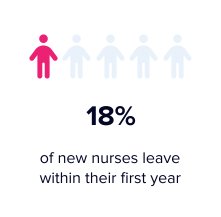
Early tenure experience. Nearly 18% of new nurses leave within their first year. Lifecycle surveys at the 90-day checkpoint represent a critical decision point when nurses determine whether to stay. Organizations that capture feedback during onboarding and early tenure can identify and address issues before departure decisions solidify.
Effective measurement for healthcare requires specialized capabilities beyond generic survey tools.
For example, Perceptyx's platform includes ANCC Magnet-approved RN satisfaction questions covering seven category areas for registered nurse satisfaction and engagement. The platform offers Leapfrog-approved and Joint Commission-recommended Safety Culture surveys designed specifically for measuring and improving safety outcomes.
Multi-channel survey delivery reaches clinical staff working shifts without regular computer access. Lifecycle surveys capture onboarding, tenure milestone, and exit experiences. Integration with HRIS and clinical systems connects employee data to patient outcomes and operational metrics.
The platform also provides healthcare-specific benchmarks allowing comparison against similar organizations by type (academic medical center, community hospital, outpatient) and role (nursing, physician, support staff).
Perceptyx customers have utilized specific approaches that generate measurable improvement.
Create visible action from feedback. UCHealth's approach includes follow-up pulse surveys specifically to ensure leaders are sharing results with their teams and acting on responses. Their confidence that feedback would drive real change increased from 47.5% to 60.5% favorable.
Implement leader rounding. Norton Healthcare adapted patient rounding practices for employees: leaders regularly ask staff how they can support them and improve their experience, providing opportunities for real-time recognition and problem-solving. For example, one leader learned about microwave shortages for night-shift workers and addressed it the next day.
Focus on manager development. Training frontline leaders in coaching, recognition, and communication skills generates cascading benefits. Advocate Health trained 6,000 leaders in action planning and achieved 85.8% of employees recommending it as a great place to work.
Address burnout structurally. One customer developed a clear burnout definition and embedded it into measurement, then implemented targeted programs. Their data shows teams where action was taken on survey results have significantly higher engagement scores.
Perceptyx research identified three employee experience factors that drive patient experience outcomes.
Safety culture. When employees believe leadership is concerned about safety events and that quality care is prioritized over quantity, patients receive safer care. Perceptyx data shows safety perceptions declined significantly over one three-year period, with belief that management is concerned about safety events falling 19 points.
Collaboration. Teams that communicate effectively deliver coordinated care and reduce gaps that harm patient outcomes. Cooperation between different departments is the most important predictor of patient safety, followed by mutual respect among team members.
Recognition. Employees who feel valued demonstrate greater commitment to quality care and stay longer. The connection runs through discretionary effort: recognized employees go beyond minimum requirements in ways that directly affect patient experience.
Technology enables listening approaches that identify turnover risk before departure decisions solidify.
One Perceptyx analysis linked exit survey data with employee perceptions captured one year prior to identify what distinguished those who stayed from those who left. Those who left experienced greater barriers to performing their jobs effectively, greater work-life imbalance, and felt their ideas were not valued.
Predictive analytics surface these patterns across large populations, allowing targeted intervention with at-risk individuals and units. Text analytics identify emerging concerns in open-ended feedback before they become widespread problems.
Multi-channel survey delivery (email, mobile, kiosk) reaches clinical staff who don't sit at desks. Integration with HRIS and scheduling systems connects engagement data with operational realities like overtime patterns and staffing levels.
The key insight: technology doesn't replace the human work of improving experience, but it identifies where to focus that work and measures whether interventions are succeeding.
Perceptyx recommends differentiated listening approaches because roles experience the organization differently.
Nurses prioritize manager support through difficult situations, scheduling fairness, staffing adequacy, and recognition. Perceptyx's Magnet-approved nursing survey focuses on seven core areas in only 24 items to preserve time for patient care.
Physicians experience unique challenges around autonomy, administrative burden, technology (especially EHR frustrations), and work-life integration. Perceptyx developed physician-specific survey items measuring and addressing these distinct needs.
Support staff (environmental services, food service, transport) often feel disconnected from the clinical mission despite playing essential roles. Connection to purpose and recognition become especially important engagement drivers for these populations.
Allied health professionals (therapists, technicians, pharmacists) share some clinical pressures while facing their own role-specific challenges around scope of practice, professional development, and cross-disciplinary collaboration.
Moral injury, the distress that results from actions or inaction that violate one's moral code, differs from burnout and requires different interventions.
Perceptyx research shows that healthcare organizations pivoted away from mission-centered culture during the past decade, with rapid changes creating distance between stated values and daily reality. Restoring alignment between organizational actions and stated mission addresses a root cause of moral injury.
Practical approaches include creating safe spaces for processing difficult experiences, reducing situations where staff feel forced to provide suboptimal care due to resource constraints, and ensuring leadership decisions visibly align with patient-first values.
Compassion fatigue responds to different interventions: managing exposure to traumatic situations, providing peer support programs, and building resilience skills. Norton Healthcare's Code Lavender program provides immediate support for employees experiencing emotional distress.
The organizations seeing the greatest improvement share common approaches.
Treat engagement like a clinical metric. Perceptyx research makes clear that employee engagement should be strategically managed, benchmarked, and tied to continuous action with the same rigor applied to patient safety and quality metrics.
Connect listening to outcomes. Use employee feedback to predict and prevent performance issues before they impact patients. The data shows that improvements closest to the employee experience, driven by managers and HR, are working.
Focus on change management. Given that change and innovation have become the top engagement driver, improve how organizational changes are communicated, how employees are supported through transitions, and how leadership decisions align with stated values.
Build continuous improvement culture. Norton Healthcare meets quarterly with service lines to review results, shares best practices among high-performing leaders through a "Culture Champions" program, and integrates survey results with other business metrics to drive organizational health.
Ready to Transform Your Healthcare Employee Experience?
Join the ranks of the world’s leading organizations leveraging Perceptyx to foster a culture of continuous, positive change.