Your Complete Retail Employee Experience Solution
Employee listening built for retail, connecting frontline voice to the business outcomes that matter most.
Trusted by leading retail organizations








The Least-Heard Workforce
Frontline Workers Drive Customer Experience but Remain the Least-Heard Workforce
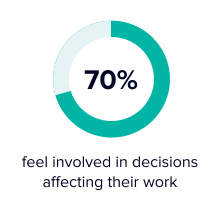
Retail benchmark data shows employees understand their roles clearly (91% know expectations) and believe in customer focus (83%), but only 70% feel appropriately involved in decisions affecting their work. That enablement gap matters because previous research identifies "getting opinions and thinking of people who work here" as a top engagement driver uniquely for retail workers. Multi-channel listening through SMS, QR codes, tablet kiosks, and mobile-first design reaches associates on their terms during shifts and breaks. When frontline voice informs operational decisions, organizations close the gap between the standards they set and the support they provide to meet them.

The Store-to-Store Gap
Performance Variation Across Locations Undermines Brand Consistency and Business Results
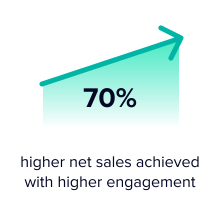
The employee experience at one location can differ dramatically from the next, and that variation shows up directly in customer satisfaction, shrink rates, and sales per square foot. Analysis of a leading global retailer revealed stores with higher engagement achieved 70% higher net sales, 6.25% higher operating margin, and 20% lower shrink. Cross-survey analytics that connect employee feedback with CSAT, sales, and loss prevention data at the store level make variation visible and actionable. Impact analyses identify which specific experience drivers separate high-performing locations from underperformers, creating a data-backed playbook for elevating lagging stores to brand standards.

The Listening Lag
High Turnover, Well-Being Strain, and Seasonal Churn Demand More Than Annual Surveys
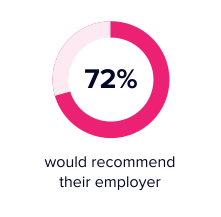
By the time annual survey results arrive, a significant portion of the retail workforce has already turned over. Benchmark data shows the warning signs are already present: fewer than 70% of retail employees report manageable stress, reasonable workloads, or sustainable work-life balance, and only 72% would recommend their employer despite 78% expressing pride in the organization. Lifecycle listening captures feedback across key moments including onboarding, 30/60/90-day checkpoints, promotions, and exit to surface the friction driving early attrition while there’s still time to intervene. Continuous pulse surveys and always-on conversational channels ensure the listening cadence aligns with workforce reality rather than an arbitrary annual calendar.

The Manager Multiplier
Inconsistent Manager Effectiveness Is Retail’s Largest Controllable Cost Driver
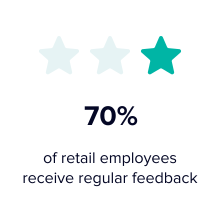
Store managers determine the daily employee experience for their teams, yet benchmark data shows their coaching capacity is structurally constrained: under 70% of retail employees receive regular performance feedback, 56% of managers carry individual contributor duties alongside people management, and more than half of frontline leaders say their challenges are mounting. Perceptyx research confirms that workers with high-quality managers report dramatically lower intent to leave. Structured 360 feedback aligned to retail-specific leadership competencies identifies where individual managers need development, while behavioral nudges delivered in the flow of work translate survey insights into daily actions without adding to an already overloaded manager role.

Science-Backed: People Insights Model
Perceptyx's People Insights Model provides the scientific backbone for transformative listening and action strategies across the retail workforce. Built on rigorous behavioral science research and benchmarked across millions of respondents, including retail-specific benchmarks for store, distribution center, and corporate populations, this model connects employee feedback directly to behaviors that drive business success.
Learn Moreabout the People Insights Model
Common Questions About Retail Employee Experience
Retail organizations operate with three fundamentally different workforce segments, each with distinct pressures, communication access, and engagement drivers. Store associates navigate customer-facing roles with schedule variability and limited email access. Distribution center teams face physical demands and shift-based coordination challenges unique to fulfillment operations. Corporate employees work in traditional office environments and focus on different strategic priorities that are often disconnected from frontline realities.
Perceptyx research found that 61% of retail workers have encountered verbally abusive or unruly customers, the highest rate across all industries. 81% report burnout symptoms. And according to Bureau of Labor Statistics data, only "accommodation and food services" experiences higher month-to-month quit levels than retail trade.
The retail employee experience is also shaped by scheduling unpredictability, physical demands of standing and lifting throughout shifts, holiday and weekend work requirements, and limited access to corporate communication channels. "Getting opinions and thinking of people who work here" ranks as a top-2 engagement driver uniquely for retail workers, yet reaching them through traditional listening methods remains complex.
Research from Perceptyx’s Center for Workforce Transformation reveals four core needs that drive frontline engagement:
Scheduling flexibility and work-life balance. Unpredictable scheduling creates stress and disengagement. Employees need advance notice of their schedules and the ability to provide input, particularly for managing personal responsibilities during weekends and holidays when retail demands are highest.
Clear communication across locations. Communication barriers emerge when workers lack corporate email or desk access. Mobile-first, real-time communication tools that reach every employee regardless of location or role bridge this gap.
Recognition and feeling valued. Frontline workers often feel invisible to corporate leadership. Well-recognized employees are 7x more likely to be fully engaged than employees who are not recognized. Meaningful, specific recognition for contributions has significant positive impact on morale and retention.
Career growth and development paths. Frontline workers are 1.3x less likely than desk workers to believe they can achieve career goals at their organization, and only 45% say managers actively support their growth. Visible and clearly defined career pathways demonstrate organizational investment in people and significantly reduce turnover intent.
Store managers are the primary connection between frontline workers and the organization. The quality of that relationship directly determines team engagement, turnover, and customer experience.
Perceptyx research confirms that among employees who rate their manager relationship as "poor" or "fair," 21.5% intend to leave the organization, more than five times the 4.3% attrition intent for those rating the relationship as "excellent." Employees with poor managers account for more than one-third of all planned departures, representing more than $300 billion in annual turnover costs to the U.S. economy.
Managers who are clear on the vision set by senior leaders are 3.3x more likely to be fully engaged themselves. That engagement increases to 7.3x when managers feel the vision fosters a sense of belonging.
Yet retail’s version of "manager squeeze" amplifies the challenge. Weekends and holidays, when most people unplug, are when retail leaders carry their heaviest operational load. District managers, general managers, and shift leaders must balance staffing challenges, customer expectations, and employee needs simultaneously. This creates lower work-life balance, higher stress, and outsized burnout risk among the leaders who shape frontline culture.
Effective retail leaders demonstrate specific behaviors that correlate with team engagement and retention. Key manager responsibilities that affect employee experience include coaching (providing on-the-floor guidance and performance feedback), scheduling fairness (creating predictable schedules that respect employees’ time), recognition (acknowledging hard work and positive contributions in a timely manner), and communication (cascading corporate information while listening to team concerns).
Research on manager effectiveness shows that leaders who support employees through difficult customer interactions see higher engagement and lower intent to leave their teams. Given that 61% of retail workers face unruly customers, this support capability separates effective leaders from those whose teams struggle.
The mismatch between annual survey cycles and retail’s rapid turnover creates systematic blind spots. Employees who leave within their first few months are never surveyed in an annual model. Feedback becomes stale by the time it reaches analysis. Low participation rates from deskless workers without easy survey access compound the problem.
Perceptyx’s State of Employee Listening research found that retail companies listen less frequently, across fewer channels, and were slower to address employee feedback than companies in other industries.
Because retail workers cycle in and out quickly, traditional annual or semiannual surveys cannot keep pace with frontline reality. Organizations that implement always-on lifecycle surveys can predict turnover with up to 85% accuracy, enabling them to identify at-risk employees before they decide to leave, understand which early experiences predict long-term retention, and compare sentiment between retained employees and those who departed.
Effective retail listening strategies combine multiple channels to reach all workforce segments and move rapidly from insight to action.
Use multiple channels to reach deskless workers. SMS surveys deliver short pulse checks directly to personal devices. QR codes posted in break rooms, on schedules, and near time clocks provide instant survey access. Tablet kiosks in common areas offer feedback stations. Manager-facilitated access through unique PIN codes allows frontline teams to complete surveys during scheduled breaks.
Carhartt achieved an 84% participation rate, the highest in company history, by deploying surveys through both email links for computer users and tablet-based access with PIN codes for store and production employees.
Prioritize speed to action. Collecting feedback without acting damages trust and can be worse than not asking. The time between collecting feedback and acting on it determines whether employees trust the process. Retailers should set targets for how quickly managers review and respond to results.
Enable managers with real-time insights. Real-time dashboards give local managers access to aggregated, confidential team feedback. This empowers them to identify issues and take immediate, localized action rather than waiting for corporate analysis. Scalable 360 feedback aligned to retail-specific leadership competencies pinpoints development opportunities for individual managers, while in-the-moment behavioral nudges translate survey insights into daily actions without adding to existing responsibilities.
Connect employee feedback to business metrics. Linking engagement data to key business outcomes like turnover, shrinkage, customer satisfaction, and sales per square foot demonstrates ROI and maintains executive support.
Multi-channel survey delivery solves the deskless worker challenge through several methods:
SMS-based surveys send short, simple pulse surveys directly to employees’ mobile phones, eliminating corporate email requirements.
QR codes placed on posters in break rooms, on schedules, or near time clocks link to mobile-optimized surveys accessible from personal devices.
Tablet kiosks set up in common areas provide dedicated feedback stations for employees who prefer not to use personal devices.
Mobile app integration embeds feedback tools into existing employee-facing applications.
Manager-facilitated access uses unique survey links and PIN codes to allow survey completion without individual email distribution.
One hospitality company with similar frontline challenges deployed surveys via three channels simultaneously, resulting in measurable correlation between survey participation and profitability.
Seasonal hiring cycles create unique listening challenges. New seasonal workers need onboarding surveys within their first two weeks to identify training gaps before they become frustrated. The 90-day checkpoint becomes critical for identifying which seasonal workers might convert to permanent roles.
Lifecycle surveys at key moments capture the seasonal employee journey:
Onboarding (14-30 days): Assess whether new hires received adequate training and resources to succeed
Early tenure (90 days): Identify the point when employees decide to stay or leave
Key milestones: Track whether early promise translates into sustained engagement at anniversaries and promotions
Exit insights: Reveal systemic patterns that point back to correctable early experiences
Analysis of exit data often reveals patterns pointing back to early experiences. Organizations experiencing early turnover can leverage department, job family, or regional demographics to understand which jobs and locations are impacted most. Comparing sentiment between retained employees and those who voluntarily left pinpoints which experience factors drive early attrition.
The data supports a direct connection between store-level engagement and financial performance.
A Perceptyx analysis of one leading global retailer found stores with higher engagement levels achieved 70% higher net sales, 6.25% higher underlying operating margin, and 20% lower shrink compared to low-engagement locations. Perceptyx distilled the high-performing store persona for these locations. Stores that implemented specific follow-up actions after customer transactions saw the greatest overall impact on customer experience.
The relationship works through multiple mechanisms: engaged employees provide better customer service, demonstrate greater vigilance against theft and loss, and create the consistent brand experience that drives repeat purchases. When retailers understand their frontline as deeply as they understand their customers, they unlock a competitive advantage few others can match.
Engaged, well-supported retail employees are more likely to deliver exceptional customer service. This connection shows up in measurable business outcomes.
Perceptyx research demonstrates that employees whose managers support them through difficult customer situations report higher engagement and lower intent to leave. With 61% of retail workers encountering unruly customers, manager support directly affects the quality of every subsequent customer interaction.
The customer experience consistency across locations depends on employee experience consistency. Store-to-store performance variation in customer satisfaction often traces back to differences in employee engagement and manager effectiveness. Organizations that measure and address this variation can identify underperforming locations before customer experience suffers and elevate underperforming stores to brand standards.
Research from Perceptyx points to four primary strategies:
Invest in manager training and support. Managers need people leadership skills, not just operational training. Investment in coaching, communication, and conflict resolution training equips them to lead their teams effectively. Employees who receive appropriate training are 6.3x more likely to be fully engaged.
Create visible career pathways. Develop and communicate transparent promotion criteria and development programs. This shows ambitious employees a future at the company, which serves as a powerful retention tool. Only 50% of frontline employees say career opportunities exist at their organization, compared to nearly 70% of desk workers.
Implement meaningful recognition programs. Move beyond generic "employee of the month" awards. Programs that allow for personalized, specific, and timely acknowledgment, including peer-to-peer recognition options, create ongoing incentive for excellence. Recognition from senior leadership follows a similar engagement pattern: 64% of desk workers say they’ve been acknowledged, compared to just 46% of frontline employees.
Build purpose into daily work. Connect daily tasks like stocking shelves or running a register to the larger company mission and direct customer impact. Helping employees see the "why" behind their work increases engagement and motivation.
Manager effectiveness in retail depends on consistent coaching, scheduling fairness, recognition, and communication. Perceptyx research found that employees with excellent manager relationships show just 4.3% intent to leave, compared to 21.5% for those rating the relationship as poor.
Interviews with retail HR leaders reveal specific practices that work:
Show employees their feedback leads to visible changes. "We prioritize our company’s open-door policy and philosophy across all departments by regularly conducting listening sessions with associates, having appreciation days, and working to build a community of care."
Focus on the 90-day decision point. "From a retention and turnover perspective, we’ve kept our eye on this 90-day point, which is when we’ve started to notice some specific areas... that’s the time when people decide to stay or leave."
Invest in leader development. "We’ve placed a focus on leaders. A lot of our leaders go through our leadership training in order to increase their effectiveness. We want them to become better communicators and listeners."
Retail consistently ranks among the highest-turnover industries. According to Bureau of Labor Statistics data, only "accommodation and food services" experiences higher monthly quit levels than retail trade.
Perceptyx analysis found that disengaged employees were 2.5 times more likely to voluntarily leave. For one client organization, this translated to a clear business case: strategic focus on employee engagement could have prevented nearly 1,000 terminations and saved more than $10 million annually.
Effective turnover reduction strategies include:
Continuous lifecycle listening can predict turnover with up to 85% accuracy, enabling targeted intervention before departures occur.
Addressing the 90-day decision point through strong onboarding experiences, early manager relationship building, and visible career pathways.
Connecting employee data to turnover costs to demonstrate ROI and maintain executive support for retention investments.
Using cross-survey and predictive analytics to provide store, district, and region managers with personalized, actionable turnover insights before employees decide to leave.
Perceptyx data consistently shows that employees are most engaged when they see a future for themselves in their organization. That future is shaped by the training, recognition, and growth opportunities they receive.
Successful retention strategies focus on:
Manager relationship quality. The 5x difference in turnover intent between employees with excellent versus poor manager relationships makes this the highest-leverage retention factor.
Speed from insight to action. Retailers that reduce churn move rapidly from collecting feedback to implementing changes and closing the loop with frontline teams before frustration becomes resignation.
Career development investment. Carhartt’s listening strategy drove engagement from baseline to 93%, the highest the company has experienced, by focusing on leadership effectiveness, communication, learning and development, recognition, and trust.
Recognition systems that feel personal. Personalized, specific, timely acknowledgment creates the feeling of being valued that generic programs fail to replicate.
The clearest ROI metrics connect employee experience scores to business outcomes retailers already track.
As noted previously, one Perceptyx analysis demonstrated that stores with higher engagement levels achieved:
- 70% higher net sales
- 6.25% higher underlying operating margin
- 20% lower shrink
Additional ROI connections include:
Turnover cost reduction. Quantify savings by multiplying reduced turnover by replacement costs (recruiting, hiring, training).
Customer satisfaction correlation. Link employee engagement scores to Net Promoter Scores, repeat purchase intention rates, and customer experience consistency across locations.
Productivity metrics. Sales per employee and per square foot, conversion rates, and operational execution measures tied to engagement levels.
Shrink reduction. Engaged employees demonstrate greater vigilance, with measurable reductions in theft, damages, and inventory loss.
For one retailer, Perceptyx found that stores with high female employee representation but low female management had the lowest engagement and smallest year-over-year sales growth. This demonstrates how workforce analytics can reveal targeted opportunities to improve talent outcomes and business performance.
Perceptyx’s benchmark database includes retail-specific comparisons across three distinct workforce segments: corporate office employees, distribution center workers, and frontline store associates.
Engagement by Industry Sector research shows that retail trade, along with accommodation and food services, experienced a decline in engagement in 2024 following a peak in 2023. Retail faces challenges including dramatic shifts in shopper behavior, inflationary pressures causing reduced spending on non-essential goods, and continuing layoffs.
Industry-specific benchmarking allows organizations to understand whether their engagement levels are competitive within retail and identify gaps requiring attention. Comparing results against industry peers provides context for whether scores indicate a problem or reflect broader industry patterns.
Employee experience is the holistic view of an employee’s entire journey with a company, from job application through exit. It encompasses everything retail workers encounter: scheduling systems, break room conditions, manager relationships, technology access, career pathways, and recognition received.
Employee engagement is a component of that experience, referring specifically to an employee’s emotional commitment, motivation, and discretionary effort at a given point in time. Engaged employees work harder, advocate for the organization, and are more likely to stay for the long term.
The distinction matters for measurement. Employee experience surveys assess the full journey across touchpoints. Engagement surveys capture the outcome of those experiences at a specific moment. Effective retail listening strategies measure both, connecting specific experience factors (manager relationship quality, scheduling fairness, recognition frequency) to engagement outcomes (intent to stay, discretionary effort, advocacy).
Each retail workforce segment has different realities requiring different listening approaches.
Corporate employees operate in traditional office environments with email access, predictable schedules, and career ladder visibility. Standard survey distribution and annual engagement measurement may work for this population.
Distribution center workers face physical demands, shift-based schedules, and limited computer access. Survey distribution through break room kiosks, SMS, or shift start/end touchpoints reaches this population.
Frontline store associates represent the largest segment, often working part-time with variable schedules. They are deskless, customer-facing, and have limited access to corporate communication. Mobile-first, multiple-channel listening meets them where they are.
Swarovski’s approach involved people leaders directly in the process, integrating participation targets into their goals and facilitating survey access for teams in retail and production areas. They offered their survey in 20 languages to ensure inclusivity across global populations.
Effective strategies allow enterprise-wide comparability through core questions while permitting regional teams to add locally relevant items addressing segment-specific concerns.
Perceptyx research on manager effectiveness identifies several emerging trends:
Assessment-driven development. Organizations like Carhartt use survey data to identify specific leadership improvement areas, then tailor development accordingly. Their "Ways of the Carhartt Leader" competencies establish assessment frameworks applicable across all levels.
Support for managers supporting difficult situations. Given that 61% of retail workers encounter unruly customers, training leaders to support employees through these interactions has become essential. Employees whose managers provide this support show higher engagement and lower turnover intent.
Recognition-focused leadership. Research shows recognition from senior leadership reaches only 46% of frontline workers compared to 64% of desk workers. Leadership development increasingly emphasizes consistent, visible recognition behaviors that reach all employee levels.
Vision clarity and belonging. Managers clear on senior leadership’s vision are 3.3x more likely to be engaged. Development programs focus on cascading vision in ways that foster belonging, which increases manager engagement to 7.3x baseline.
Prioritization should follow the data. Perceptyx’s approach uses driver analysis to identify which experience factors most strongly influence engagement and turnover at each organization.
Common high-priority areas based on retail research include:
Manager relationship quality affects turnover intent by 5x and accounts for one-third of all planned departures.
Recognition gaps show 7x engagement difference between recognized and unrecognized employees.
Career development visibility where frontline workers are 1.3x less likely than desk workers to see opportunities.
Difficult customer support given 61% of retail workers face unruly customers with cascading effects on engagement and retention.
The highest-leverage improvements address factors that both score low in current measurement and show strong correlation with business outcomes. This varies by organization: some retailers find scheduling fairness drives turnover; others discover training adequacy predicts customer satisfaction scores.
Transform Your Retail Employee Experience Today
Perceptyx is your specialized EX partner connecting frontline experience to measurable business outcomes.