Change management solutions that make transformation stick
Perceptyx connects continuous listening to manager coaching, behavioral nudges, and skill building through every phase of change.
Trusted by the Fortune 1000
Customer Impact Stories:
- 99.8% manager action plan completion rate
- $4.7M in turnover cost avoidance
- $175M in projected efficiency gains
- 100% leader action plan completion for 2 consecutive years
- 65% survey participation, up from 58% across 74,000 employees
- 10,000+ unique listening portal views
- 32,400 hours saved per week across 12,000 employees
- 40,000 AI licenses distributed in one year
- 10,000+ individual GPTs created by employees
Why Most Change Initiatives Stall Before Adoption
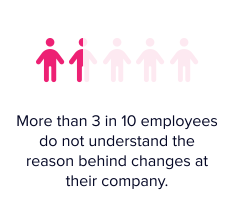
Most transformations arrive with a plan, a deck, and a communication calendar, yet still lose momentum within months. Most EX and L&D systems supporting change were never designed to connect what leaders announce to what employees actually experience.
The Resistance Wall
Employee Resistance Derails Well-Planned Change
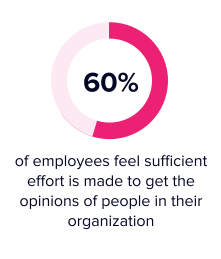
Executives who shape the strategy report feeling supported and involved; the individual contributors asked to carry it out do not, and the initiative stalls in the middle manager layers where adoption is facilitated. Continuous listening shows where resistance occurs and what is behind it early enough to answer the concern before the investment is lost.

The Snapback
Behavior Reverts After the Rollout Ends
Training completes, dashboards show attendance and completion, and six months later teams are working the way they always did. Lasting adoption requires training through Socratic conversational learning, followed by validated comprehension, and then reinforcement in the flow of work: behavioral nudges and coaching that keep the new way of working in front of managers and employees until it becomes the default.

The Sponsorship Fracture
Leadership Misalignment Breaks Mid-Initiative
Initiatives launch with executive commitment and lose it under quarterly pressure, and employees notice before the steering committee does. Measuring leader and workforce perceptions side by side exposes alignment gaps while they are still fixable, and nudges keep the sponsor behaviors in front of leaders through the hard middle of the initiative.

The Values Gap
Stated Culture Fails to Translate Into Daily Behavior
The values on the wall and the behavior in the Tuesday meeting diverge, and employees trust the meeting. Tying each cultural priority to specific, measurable manager and team behaviors closes the distance between what leadership says and what employees live. Conversational learning teaches the behavior, nudges reinforce it in the flow of daily work, and the next listening event shows whether it held.

The AI Readiness Gap
Technology Outpaces Human Readiness
AI pilots scale on infrastructure timelines while workforce skills and trust move at their own pace, and adoption stalls in the gap between them. Listening data shows which teams are ready to adopt, which need training, and which are hesitant for reasons training alone will not resolve. Conversational learning meets each employee at their own level of AI experience, scoring comprehension message by message so no one finishes until they can demonstrate understanding.

The Fatigue Spiral
Concurrent Initiatives Exhaust Adoption Capacity
Each change lands on a workforce still absorbing the last one, and even changes employees support deplete the capacity to take on the next. Measuring change perceptions directly gives leaders line of sight to sequence initiatives, clarify what stays the same, and protect the energy adoption requires.

Science-Backed: People Insights Model
The People Insights Model is the scientific backbone of the Perceptyx People Activation System: 10 Factors, 90 Research-Backed Behaviors, and 2,000+ Behavioral-Science Actions built on 20+ years of benchmarked employee experience data. For transformation and change, recommended items for point-in-time, lifecycle, and 360 feedback programs go deep on the factors proven to relate most strongly to transformation outcomes, including change management and continuous improvement, with more than 700 benchmarked items available to extend any listening event.
AI agents carry the signal from listening to action. The Narrative Analysis Agent reads every open-text comment to surface how change is actually landing across departments and job levels, while the Coaching Agent and the Nudge Agent reinforce the specific behaviors each transformation requires, in the tools managers already work in, until new behavior becomes how the organization operates.
Behind the platform sits an in-house team of I/O psychologists, behavioral scientists, and employee experience leaders. Workforce Transformation Consultants partner with your team on listening strategy, facilitated interventions, and impact measurement, building an Insights & Action Blueprint that puts the right actions in front of the right people at the right moments of the change.
Learn Moreabout the People Insights ModelFrequently Asked Questions About Change Management
Change management is the structured practice of guiding people through organizational transitions such as restructures, technology roll-outs, mergers, and strategic pivots. The discipline has shifted from communication planning toward continuous employee listening, which gives leaders real-time evidence of how change is landing and where to intervene.
Perceptyx research across 20 million survey responses recorded the largest shift in engagement drivers ever measured: change management now ranks as the single strongest predictor of employee engagement, even as perceptions of how change is handled have declined for two consecutive years. Organizations that manage change well protect engagement, retention, and execution at the same time.
The 5 C's are Case for change, Clarity, Communication, Capability, and Commitment, and measuring all five through continuous dialogue with employees shows leaders which one is failing before the initiative does. Most stalled transformations trace back to a weak Case for change or Capability gap that communication alone cannot fix.
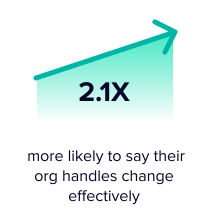
Successful efforts treat change as a continuous process rather than an announcement, pairing transparent communication with listening and visible action at every stage. Perceptyx benchmark data shows employees who agree that people in their organization communicate openly and honestly are 4.4x as likely to say change is handled effectively.
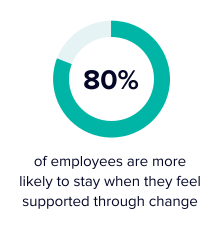
Start by finding out where resistance actually lives: research on change readiness across job levels shows executives feel far more supported and involved through change than individual contributors. Closing that divide with targeted listening, involvement, and manager support converts resistance into feedback, and employees who feel supported through change are 66% more likely to be fully engaged.
Collecting feedback without acting on it erodes trust faster than never asking. Six practices, from assigning clear ownership to closing the loop visibly with employees, separate organizations that turn listening into meaningful change from those that generate reports.
Attrition during transformation often becomes a self-fulfilling prophecy: leaders assume people will leave, communicate defensively, and the best performers read the silence as a signal. Organizations that embrace change openly while investing in their strongest people keep the talent the transformation depends on.
Change fatigue peaks in organizations running the most listening and change programs at once, and the fix is prioritization rather than more communication. Research on listening and action practices shows 71% of organizations share survey results while only 51% of employees see improvements from their feedback; closing that action gap restores the credibility each new initiative draws on.
Managers translate strategy into daily experience, and Perceptyx manager self-assessments rank effectively managing change as the third-highest area where managers want coaching. The managers who lead change well do three things differently: they clarify what people need to do, keep development conversations alive through the transition, and continuously update their own picture of what teams are experiencing.
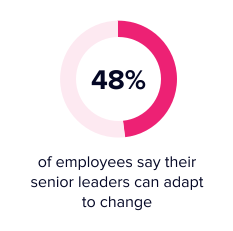
Be honest about what is known and what is still unfolding, explain the rationale behind decisions, and clarify what will stay the same. When senior leaders communicate change clearly, employees are 4.1x more likely to be extremely confident in leadership's ability to guide the organization through transitions.
Employee sentiment moves first, group-level indicators like adoption and retention follow, and business outcomes confirm the result. Nudge reporting shows which managers are acting and validated comprehension data shows which teams can execute the change, while predictive people analytics connect those shifts to other outcomes leadership tracks, so course correction happens during the change instead of in the post-mortem.
Comparing executive survey responses against the rest of the organization exposes blind spots, the items leaders rate as strengths that employees experience as gaps. Leaders who continually update their mental map against the data catch misalignment before it fractures sponsorship mid-initiative.
Layoffs reshape culture for everyone who stays: 58% of employees say they are more likely to look for a job elsewhere after a layoff, even when their own role is unchanged. Transparency changes the outcome, and among employees who said layoffs were communicated openly, 61% remained fully engaged, 3x the rate of those who experienced silence. Three practices support employees through the cuts and the aftermath.
Culture initiatives fail when stated values never connect to measurable behaviors and outcomes. Employee listening data anchors continuous improvement by tying cultural priorities to goal alignment and benchmarks, which matters most during mergers and major policy shifts. Behavioral nudges reinforce those behaviors week after week, which is how a stated value turns into a habit.
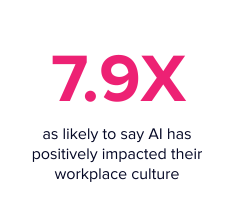
The divide in how employees experience AI comes down to implementation. Employees in organizations with leadership-driven AI policies are 7.9x as likely to believe AI has positively impacted their workplace culture compared to those in organizations with no formal approach.
Only 17% of organizations have a leadership-driven AI adoption strategy, yet those that do report 62% engagement and 83% team cohesion, while unguided environments see 1 in 3 employees reporting AI-related tension between teams. New data on AI's cultural impact shows transparent communication and proactive skill development make the difference.
Manufacturing has always run on change; what is different now is automation, digital transformation, and global disruption arriving at once. Workforce Panel data from manufacturing employees shows change holds where organizations invest in development, strong teams, and leadership that listens, and stalls where those conditions are missing.
RTO is a change initiative like any other, and mandates without listening carry measurable risk: 46% of employees say they would quit if required to spend more time in the office, while executives and frontline workers hold sharply different views of remote productivity. One year into the debate, the organizations getting it right test policies with smaller teams and adjust based on feedback before enterprise-wide rollout.
Most change initiatives assume the workforce can execute the new operating model on announcement day, and most cannot. Develop builds the capability the change depends on through adaptive, conversational learning that adjusts to the individual learner and scores comprehension as it goes, so readiness is established before go-live instead of assumed.
Completions and quiz scores measure clicking; validated comprehension measures whether someone can put the new way of working into practice. Conversational learning evaluates each learning objective as that ability is demonstrated live, and organizations that run listening and learning as one system use those scores to see which teams are ready for the change and which need another pass before go-live.
Randomized controlled research by Haunstrup & Jensen (2024) found that training paired with reinforcement nudges produced behavior change that held at 8 months (Cohen's d = 0.31–0.34), while training alone did not. For transformation leaders, the implication is to budget for the reinforcement layer, since the durability of the change lives there.
Behavioral nudges and AI-powered coaching delivered in the flow of work, targeted by listening data to the specific behaviors each change requires. Activate supplies that reinforcement layer, so the gains from a rollout compound instead of decaying.
The Perceptyx Transformation & Change Guidebook covers best practices, stakeholder questions for senior leaders, HR, managers, and employees, the five lifecycle moments that matter for change, and the metrics that show whether transformation is landing.
Ready to Build an Engagement Program That Drives Business Outcomes?
Plenty of organizations run engagement surveys, but the value only shows up when those surveys connect to manager action and improvement you can measure over time. A conversation with our team starts with your current program, what's working in it, and where the biggest opportunities for improvement remain.