Learning and Development That Builds Better Employees
Identify which leaders and employees need development, deliver personalized learning in the flow of work, and measure improvements in engagement, retention, and performance.
Customer Impact Stories:
- 99.8% manager action plan completion rate
- $4.7M in turnover cost avoidance
- $175M in projected efficiency gains

- 9% overall turnover improvement
- +13% confidence that feedback would drive change
- 97th percentile survey effectiveness

- 96% survey response rate achieved
- 2.8pt increase in guest experience scores
- 60% team member engagement on social initiatives

Why Learning and Development Investment Stalls
Organizations are spending more than ever to develop their people, but lack the ability to deliver L&D in the flow of work, validate comprehension, or demonstrate ROI after the fact.
The Pipeline Gap
Leadership Depth Erodes Faster Than Organizations Can Rebuild It
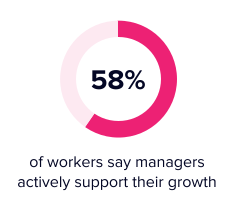
Critical roles sit unfilled because succession planning relies on tenure and instinct rather than behavioral data. Perceptyx research found that 58% of HR managers want to abandon people management entirely, as they're caught between performance pressure and employee demands. That means the pipeline leaks from the middle.
360 feedback and AI-assisted development identify managerial readiness from actual competency data and surface high-potential employees who would otherwise go unrecognized. Each person routes into targeted development and reinforcement rather than receiving a score and a hope they act on it.

The ROI Blind Spot
Insight and Learning Operate in Silos, So Neither Delivers Measurable Impact
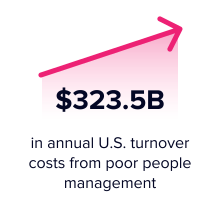
Organizations spend more than $400 billion annually on learning and development and billions more on employee listening, yet the systems that find development gaps and the systems meant to close them rarely connect. Poor people management costs the U.S. economy $323.5 billion in turnover and up to $204.9 billion in lost productivity annually, and most development programs still measure completion rates instead of verified learning and behavior change.
Closing the gap takes a system that can identify what needs to change, deliver personalized development in the flow of work, and prove the learning translated into performance.

The Promotion Trap
Employees Promoted on Individual Performance Fail Without Training
Organizations routinely promote top individual contributors without the coaching, feedback infrastructure, or competency assessment to support the transition. Those employees account for more than a third of all planned departures across the workforce.
When an employee's 360 results or team engagement scores flag a specific gap, the platform delivers a conversational learning experience targeting that exact behavior, then reinforces it through just-in-time nudges and coaching until the change holds.

The Targeting Gap
Without Behavioral Data, Development Dollars Go to the Wrong People on the Wrong Skills
Linking leader assessment results to team-level engagement and retention signals answers the hardest targeting question in learning and development: which employees need development, on what, and why it matters to the business right now.
When 360 feedback, engagement data, and team sentiment feed a single targeting layer, each person routes into a personalized learning path built around specific competency gaps rather than a generic curriculum. Connecting these data sources extends that reach to the full workforce without proportional increases in L&D headcount or budget.

Science-Backed: People Insights Model
Plenty of platforms produce a leadership score. The People Insights Model goes further. Built on behavioral science and 20+ years of benchmarked responses, it isolates the manager behaviors that predict engagement, retention, and performance, like coaching, communication, and recognition, and ties each to the outcome it moves. When a leader's 360 or engagement data flags a gap, it names the specific behavior to work on rather than handing back a generic score.
Those behaviors feed one connected system. Perceptyx AI Agents read feedback at scale and route each leader into development built around their gaps, turning content the organization already owns into adaptive, conversational experiences that check comprehension as it happens. Coaching and behavioral nudges reinforce the new behavior inside Slack, Teams, and the tools managers already use, and that activity ties back to follow-up survey trends, connecting a development action to a change in engagement and retention.
Our Workforce Transformation Consultants add the human layer, practitioners who run development programs inside large organizations and work alongside HR to design assessments, interpret results, and facilitate action planning at scale, so an L&D leader is never left alone with a dashboard.
Learn Moreabout the People Insights Model
Common Questions Learning and Development
Learning and development is the organizational function that builds employee capability through training, coaching, and structured growth experiences, so people can perform in their current roles and grow into new ones. Treated well, it is a driver of business performance rather than a cost line: organizations that invest in L&D see materially higher full engagement among employees who get the right training, and development consistently ranks among the strongest predictors of retention. The common failure is owning extensive content that employees never access, which is why effective L&D connects learning to what feedback tells the organization people actually need and delivers it in the flow of work.
An L&D team identifies capability gaps, designs and delivers learning to close them, and measures whether the learning changed performance. In practice that means partnering with the business to define needs, building or curating content, delivering it through the right mix of coaching, courses, and on-the-job experiences, and tracking impact. A listening strategy is both the trigger and the measuring stick for that work: surveys surface where development is needed and which programs are working, so the team invests where it moves outcomes rather than guessing. Tracking impact also protects the function itself. Teams that can show learning moved retention or performance keep their budgets and their standing in strategic planning; teams that report only activity get treated as a cost center when budgets tighten.
A learning and development strategy aligns development to business goals: it defines the capabilities the organization needs, identifies where the gaps are, and lays out how learning will close them and how impact will be measured. The methods that work have shifted, with asynchronous digital and AI-powered approaches now eclipsing traditional one-on-one coaching for scale, and organizations with effective programs are roughly 2.3x more likely to meet financial targets. The differentiator is clearly defined outcomes and a feedback loop that lets the strategy adapt as needs change.
Most L&D programs struggle to show impact because they measure activity, like completions and hours, rather than whether capability actually changed and translated into performance. A completion record confirms someone reached the end of a module; it says nothing about whether they understood the material or whether any company goal moved as a result. Many newer tools have bolted AI features onto that same model, generating course content faster while still measuring completions, so organizations arrive at the wrong destination sooner. Content sits unused, training fades once people return to their routines, and the data needed to connect learning to business outcomes lives in systems that were never built to talk to each other. Closing that gap takes development that reaches people inside the workday and measurement that verifies the result.
Closing a skills gap starts with a clear read of which capabilities the business needs and where the workforce falls short, then routing targeted development to those specific gaps rather than running generic training. Upskilling and reskilling only count if the new capability lands and gets applied, so the programs that work pair learning with reinforcement in the flow of work and follow-up measurement. Delivering that reinforcement where employees already work is what turns a skilling initiative from a completion dashboard into capability that connects to retention and internal mobility.
Training sticks when it addresses the specific challenge someone faces, gets reinforced over time, and is checked for real comprehension rather than attendance. One-time sessions fade quickly because there is no reinforcement and no signal of whether anything was understood. Pairing learning with personalized, AI-driven reinforcement based on each person's feedback keeps development relevant between formal sessions, which is the mechanism that produces durable behavior change rather than a brief lift that decays within weeks.
Continuous learning gives employees visible paths to grow, which is one of the strongest reasons people stay, and it keeps the workforce adaptable as roles change. When development is ongoing rather than a once-a-year event, employees see that the organization is investing in their future, and career growth conversations become part of regular work instead of an annual ritual. Extending structured, data-grounded coaching to every employee, beyond the senior leaders who usually receive it, is how organizations make continuous growth real across the full workforce rather than a perk for the few.
Conversational learning teaches through an adaptive, back-and-forth dialogue rather than a fixed module followed by a quiz. Instead of clicking through slides, the learner works through the material in a guided Socratic conversation that adjusts to their answers and checks understanding as it goes. The approach grew out of AI-native learning platforms that turn static content into personalized, cognitively grounded experiences, and it scales one-on-one tutoring to a whole workforce. The difference that matters here is evidentiary in nature: a conversation can confirm a person understood and could apply something, where a completion record only confirms they reached the last page.
Learning in the flow of work means development that fits into the workday, in the tools people already use, such as Slack and Microsoft Teams, rather than pulling them out for separate training sessions. The preference is close to universal: research across more than 4,200 employees found roughly 80% at every job level want learning embedded in their work, yet only about two-thirds say it is meaningfully integrated today. It matters because time is the most common barrier to development, and learning that interrupts work competes with the job, while learning embedded in work reinforces it.
Most measurement stops at proxies: seat time, completion, a quiz score, a satisfaction survey. None confirm a person understood the material or can apply it on the job. Newer approaches assess comprehension as the learning happens, against defined objectives, rather than relying on a post-training test, producing a record of demonstrated capability instead of attendance. The practical test is whether the measurement tells you someone can do the thing, since that is the signal that connects to performance, not the click that connects to a completion dashboard.
The forgetting curve is the main culprit: the average person loses roughly 70% of new training within 24 hours without reinforcement, so a one-time session fades fast once people return to their routines. AI is shortening the shelf life of skills further, because roles change faster than annual training cycles can keep up. The fix is not more content but spaced reinforcement and application: development that returns to the same behavior over time, checks whether it stuck, and reinforces it in the flow of work until it holds.
Talent development is the systematic building of employee capability through targeted learning experiences and career progression paths. The most effective programs combine leader assessment data with research showing people want learning that is personal, practical, and purposeful, with one-on-one coaching, on-the-job mentoring, and certifications ranking among the highest-impact methods. Strong talent strategies pair leadership competencies with role-specific skills to build development journeys for current and future organizational needs, around behaviors such as inspiring others, developing talent, communicating vision, valuing people, and driving innovation.
Leader development builds the specific competencies and behaviors that let an individual guide teams, deliver results, and work through organizational complexity. It uses 360 feedback to provide multi-rater perspectives that pinpoint where performance can improve and align a leader's behaviors with company goals. Organizations that run a structured 360 process see better team cohesion, stronger accountability, and tighter alignment between leadership behavior and business strategy, anchored to a clear model of the behaviors that define an effective leader.
Talent development protects the capability an organization needs to perform now and to adapt as roles change, and it is one of the clearest signals to employees that the company is investing in their future. Career growth and development consistently rank among the strongest predictors of retention, so connecting development to what employee listening surfaces keeps high performers engaged and reduces the cost of replacing them. Without it, skills gaps widen, internal mobility stalls, and the bench thins precisely when the business needs depth.
Effective development starts by identifying real gaps from feedback and performance data, then delivering targeted learning, coaching, and stretch experiences rather than a generic curriculum. Development works best in layers: the organization provides infrastructure and protected time, managers hold career conversations and open growth opportunities beyond promotions, and individuals own their learning. Pairing each of those with reinforcement and follow-up measurement is what turns development activity into capability that holds.
Top managers use data rather than instinct: they connect work to the larger mission, give continuous feedback, recognize progress, make room for collaboration, and offer support before it is asked for. Identifying high-potential talent means looking past performance scores alone to the behavioral signals that predictive analytics can surface across survey and feedback data, so emerging leaders who would otherwise go unrecognized get development before they are needed. Employees are markedly more likely to be fully engaged when their leader is strong at developing people.
A leadership development program is a structured set of experiences that builds management and leadership capability over time, ideally tied to the organization's leadership model and to actual employee feedback. The strongest programs move past once-a-year classroom events, which fade fast once managers return to their routines, toward development reinforced continuously between formal sessions. That shift, from event to system, is what flattens the forgetting curve and produces behavior change that lasts.
Leadership quality is one of the single biggest influences on engagement, retention, and performance, since a manager shapes the day-to-day experience of everyone on the team. The difference between an effective and an ineffective manager shows up directly in whether people stay and how they perform, which is why the cost of poor management runs into the hundreds of billions annually. Developing leaders is the single most effective way to move those numbers, because the effect multiplies across every team each leader touches.
Start by defining the leadership behaviors that matter for your strategy, then assess current leaders against them with 360 feedback and engagement data to find the real gaps. Route each leader into targeted development built around those gaps, reinforce it with coaching and nudges in the flow of work, and measure whether team outcomes move in follow-up surveys. The research behind AI-driven manager enablement shows that connecting assessment to continuous reinforcement, rather than relying on standalone workshops, is what makes a program both scalable and measurable.
Most learning programs are built against competency frameworks designed for a business that no longer exists. By the time a curriculum gets approved and deployed, the priorities it was built around have shifted, leaving L&D defending spend on programs that don't map to what leaders actually need right now. Alignment requires a live connection between workforce signals and development design. When engagement data, 360 feedback, and business performance indicators feed the same system as learning delivery, programs can be built and adjusted against current gaps rather than last year's strategic plan. The organizations that get this right improve their L&D ROI and give the C-suite a reason to treat learning as a strategic lever rather than a discretionary line item.
ROI comes from connecting development activity to business outcomes rather than counting completions. Track both leading indicators, like engagement lift and feedback quality, and lagging indicators, like retention, promotion rates, and business results, then tie them back to specific development actions. A mature people analytics practice is what lets HR isolate the impact of a program and translate it into the financial language executives already use, moving leadership development from an act of faith into a measurable investment.
Development aligns growth opportunities with employees' aspirations and career stages, and the investment itself signals that the organization is committed to their futures. Perceptyx research finds employees satisfied with their learning opportunities are more than 3x as likely to be fully engaged (66% vs. 19%) and 2.6x as likely to recommend their organization as a great place to work. The emerging model connects 360 feedback to continuous enablement: survey data identifies gaps, targeted leaders receive coaching and nudges between formal interventions, and subsequent surveys confirm whether team-level outcomes improved.
Coaching and mentorship accelerate development by giving leaders personalized support to work through real organizational challenges, especially the large middle and frontline manager population that classroom programs underserve. Managers who receive coaching are more likely to be fully engaged and to manage stress well, yet only about half currently receive ongoing coaching despite far more wanting it. Experience-aware AI coaching closes that gap by extending personalized guidance to every manager, grounded in their own team's feedback rather than generic advice.
The strongest people analytics tools integrate 360 feedback, performance data, and engagement metrics, then use AI to surface development priorities and forecast talent risk instead of only reporting what already happened. Building that capability takes more than software: it depends on connecting people data to business outcomes and pairing the platform with the expertise to translate findings into action HR can implement. Tools that combine that analytical depth with clear governance let HR identify high-potential talent and prove business impact.
Talent development builds skills across the entire workforce to raise capability at every level and strengthen the bench. Leadership development targets the specific competencies needed to manage teams, set strategy, and influence others. The two are complementary: broad talent development identifies emerging leaders, while targeted leadership development prepares specific individuals for people management and strategic decisions. Organizations benefit most when both connect through a shared assessment, action, and measurement system rather than running as separate, disconnected programs.
The 5 C's commonly refer to Character, Competence, Connection, Communication, and Contribution: integrity and self-awareness, the skills to do the job, the ability to build relationships, clear two-way communication, and measurable impact on the team and organization. Most leadership models, including Perceptyx's research-backed competency framework, organize behaviors into a small set of dimensions like these so feedback stays clear, observable, and tied to outcomes rather than to abstract traits.
Most organizations see behavioral change within three to six months when structured development is paired with ongoing coaching and nudges, with measurable business impact on retention and team performance typically emerging over 12 to 24 months of sustained effort. Perceptyx clients have recorded 8 to 12 point improvements in targeted leadership focus areas within six months under that model. Programs that connect assessment data to personalized action and reinforcement see results sooner than those built around periodic classroom events, a pattern confirmed across a decade of longitudinal engagement research.
Budgets vary with organization size and program scope, but most span four areas: leader assessment tools such as 360 platforms, leadership content such as workshops and e-learning, coaching and mentorship, and the technology to track progress and impact. Total spend matters less than where the dollars go: development at the frontline and middle-manager level often returns more than the same investment concentrated at the top. Budgeting for reinforcement and measurement, beyond the initial program, is what protects the return.
Yes, and they need to account for the specific challenges of leading distributed teams, including maintaining visibility into team sentiment across locations and building connection without physical proximity. Perceptyx research shows that two out of three managers believe remote and hybrid employees have fewer growth opportunities than on-site peers, and that those managers spend less time connecting with the people they see less often. Continuous listening and AI-delivered coaching reach remote leaders in the tools they already work in, so development and feedback stay equitable regardless of where someone sits.
Ready to Connect Leadership Listening to Leadership Growth?
Perceptyx combines 360 feedback, engagement data, and conversational AI learning and coaching in a single platform so you can identify which leaders need development, deliver personalized learning that builds real comprehension, reinforce new behaviors in the flow of work, and prove capability actually changed. See how organizations like Solenis have saved millions in talent turnover costs by closing the gap between insight and action.