The State of Learning and Development
Can Employees See Where Learning Is Taking Them?
Zachary Warman, M.S.
Senior Behavioral Scientist, Perceptyx
Executive Summary
As work and skill requirements continue to change, learning and development has an increasingly important role in preparing employees for what comes next. This inaugural State of Learning & Development report establishes a 2026 baseline for how employees experience learning, development, and the organizational conditions surrounding them. The study draws on a July 2026 Perceptyx Workforce Panel of 2,992 employed individuals across North America and Europe. The data shows that employees appear to recognize that need: 74% say they know which skills they personally need to develop to remain successful. Many also report that learning already translates into meaningful changes in how they work.
The greater challenge is seeing the organizational path around that development. Sixty-two percent of employees say their organization makes it clear which skills will matter most in the future, 60% believe it is actively helping employees build skills for future roles, and only 56% see a clear learning strategy for the next one to two years. In other words, employees often understand their own need to keep developing without having the same visibility into what the organization is preparing them for or how it plans to get them there. The strongest L&D experiences close more of that gap by making learning relevant to the work, providing clearer direction, and giving employees greater visibility into what their development can make possible.
For L&D leaders, the opportunity is to create greater clarity and connection around development, not just to provide more learning opportunities. Employees need to understand how learning relates to business priorities and future capability needs, while also having the support to put new capabilities into practice. Looking beyond participation to how employees understand, apply, and sustain what they learn provides a fuller picture of success. Four questions provide a practical lens for doing so: Where are we going? Why does it matter? Where can it take me? How will I use it?
Key Findings
-
74%
know which skills they personally need to develop
-
56%
see a clear learning strategy for the next 1-2 years
-
57% vs. 21%
fully engaged among employees experiencing more- vs. less-effective L&D
-
75% vs. 43%
executives vs. individual contributors who see a clear learning strategy
Why L&D Matters Now
The skills organizations need are changing quickly. The World Economic Forum estimates that 39% of workers’ core skills will change by 2030, with roughly six in ten workers expected to need upskilling or reskilling over the same period. Technology is one driver, alongside economic uncertainty, demographic shifts, and other changes reshaping jobs and business priorities.
AI makes the pace of that change especially visible. Perceptyx research finds that 60% of employees already use generative AI for work at least occasionally. However, only 43% say their organization is helping employees build the skills needed for an AI-enabled workplace. As AI becomes increasingly integrated into work, many employees find that change is outpacing their own development.
That puts L&D in a difficult position. Organizations need to address today’s capability gaps while anticipating skills that may become more important as roles continue to evolve. Recent SHRM research illustrates how heavily that balance currently leans toward the near term. Seventy-two percent of HR professionals say their organization’s L&D strategy is primarily driven by skills needed within the next one to two years, compared with just 4% who say it primarily focuses on longer-term skill needs.
Learning at scale is increasingly part of how organizations respond to change. The challenge is making sure employees can see where that learning is taking them. Building workforce capability requires more than adding courses as new needs emerge. Employees need enough clarity to understand which capabilities matter, how development connects with the work and opportunities ahead, and how they will be supported in putting new skills to use. That is the environment this report examines.
Stats Overview
-
39% of workers’ core skills expected to change by 2030 World Economic Forum
Stats Overview
-
60% of employees already use generative AI for work at least occasionally Perceptyx Workforce Panel
Stats Overview
-
72% of HR professionals say L&D strategy is primarily driven by skills needed within 1-2 years SHRM
Stats Overview
What Do We Mean by Learning & Development?
-
Learning and development (L&D) extends beyond formal training, courses, or learning platforms. In this report, L&D refers to the broader organizational system through which employees build, apply, and extend their capabilities over time.
-
Learning The experiences through which employees acquire or strengthen capabilities, including formal programs, coaching, feedback, peer learning, practice, and learning embedded within everyday work.
-
Development How capabilities grow over time and what they make possible, including career growth, mobility, reskilling, and preparation for changing roles.
-
The Environment Around Them The strategy, time, manager support, opportunities for application, and connection to organizational priorities that shape how learning and development become part of how work gets done.
-
This broader definition matters because positive learning experiences can exist without employees seeing a clear development system around them. In this report, that system refers to how learning opportunities, organizational priorities, development pathways, and the support for applying new capabilities work together over time. Employees experience the system through the connections they can see between those pieces. The findings that follow examine both sides of that experience.
Four Questions Every Employee Should Be Able to Answer
Learning and development can include many different experiences. Employees do not need visibility into every part of an organization’s L&D strategy, but they do need enough clarity to understand what they are developing toward, how learning connects with their work, what it can make possible, and how new capabilities can be put into practice.
The findings in this report point to four questions that can help leaders assess how clearly those connections come through in the employee experience.
-
DIRECTION
Where are we going?
56% see a clear learning strategy for the next 1-2 years.Direction reflects employees’ visibility into the capabilities the organization is preparing for and how learning supports those priorities.
-
CONNECTION
Why does it matter?
61% see learning programs as connected to broader business priorities.Connection describes how development relates to employees’ work and the priorities the organization is trying to achieve.
-
DESTINATION
Where can it take me?
59% see career opportunities for themselves within their organization.Destination captures what building new capabilities can make possible, including growth, mobility, reskilling, or changing responsibilities.
-
REINFORCEMENT
How will I use it?
58% say employees have enough time during working hours for development.Reinforcement encompasses the time, support, and opportunities that allow employees to put new capabilities into practice.
These questions are connected, but they do not always move in a coordinated fashion. Employees may understand what skills will matter without seeing where those skills could take them. Additionally, learning can feel relevant to today’s work while the longer-term direction remains unclear. Even when employees understand the purpose of development, they still need the opportunity and support to put new capabilities into practice.
Together, the four questions provide a practical way to examine where an L&D system is clear to employees and where important connections may be more obscure.
Learning Is Working.
Is the System Around It?
For organizations facing continued changes in work and skill requirements, making learning available is only one part of preparing employees for what comes next. Development also needs to help employees build capabilities they can use today while giving them a clearer sense of how those capabilities fit with the work and opportunities ahead.
The global findings begin from a position of relative strength. Nearly three-quarters of employees (74%) say learning happens within the daily flow of work, 73% say it produces lasting behavior change, and 71% say people apply what they learn. The same proportion say learning opportunities help employees perform their jobs more effectively. Across these measures, employees generally see learning translating into something useful when they experience it.
The L&D Comprehension Gap
Employees are more favorable about what learning does than about the strategy and conditions surrounding it.
The Learning Experience
The Learning Experience
The L&D Environment
The L&D Environment
Strong learning experiences do not automatically add up to a development system employees can see and navigate.
However, individual learning experiences do not automatically add up to a coherent development system. Employees can apply a new skill without understanding how it connects to future roles, and development can be available without making longer-term capability priorities clear. Even valuable opportunities can be difficult to use when learning must compete with the demands of day-to-day work.
Taken together, the findings show that employees generally see value in learning itself, but have less visibility into the broader path around development. The sections that follow look more closely at the connections employees can see between learning, their work, and what comes next.
Preparing for Work That is Still Changing
Employees appear to understand that the capabilities they need will continue to evolve. Nearly three-quarters (74%) say they know which skills they personally need to develop to remain successful. However, the organization’s direction is less comprehensible. Sixty-five percent say their organization’s learning approach keeps pace with changing skill requirements, while 62% say their organization makes clear which skills will matter most in the future. Sixty percent believe their organization is actively helping employees build skills for future roles.
This leaves some employees with a clearer view of their own developmental needs than of the capabilities their organization is preparing for. Knowing that new skills are needed is a reasonable starting point, but employees also need enough visibility into the organization’s direction to understand where to focus their development and how those capabilities may fit into future work.
Employees See Their Own Needs More Clearly Than the Path Ahead
Employees have greater clarity about the capabilities they personally need than about how their organization is preparing them for future work.
Employees See Their Own Needs More Clearly Than the Path Ahead
|
I know which skills I need to develop to remain successful
74% |
|
Learning keeps pace with changes in my role and responsibilities
65% |
|
My organization makes it clear which skills will matter most in the future
62% |
|
My organization is actively helping employees build skills for future roles
60% |
|
Percent Favorable
0% 25% 50% 75% 100% |
Preparing Employees for Future Roles
Employees who see their organization actively building skills for future roles are also much more likely to see a clear path for reskilling. Among this group, 83% say their organization provides clear pathways for employees to reskill as job requirements change, compared with 28% among employees who do not see the same emphasis on future-role preparation.
The same groups differ substantially in how they view the broader development environment. Employees who believe future-role preparation is occurring are also more favorable about the clarity of their organization’s learning strategy, the connection between learning and career opportunities, leaders modeling continuous learning, and the organization’s use of employee feedback to improve development.
These relationships are correlational and should not be interpreted as evidence that any single practice causes another. However, they do show how future preparation can look different when employees also see the pathways and organizational support around it.
Future-ready L&D looks less like a catalogue of emerging skills and more like a connected system that helps employees see the capabilities that matter, the pathways available for building them, and how continued development fits into their future with the organization.
Knowing that new skills are needed is a reasonable starting point, but employees also need enough visibility into the organization’s direction to understand where to focus their development and how those capabilities may fit into future work.
What Separates Stronger L&D Experiences?
What Separates Stronger L&D Experiences?
Employees who rate their organization’s approach to L&D more favorably report stronger experiences across relevance, strategy, organizational support, and future preparation.
What Separates Stronger L&D Experiences?
Legend
| Item |
|---|
|
Learning is relevant to real work
74%
30%
44pts |
|
Clear learning strategy
65%
21%
44pts |
|
Leaders treat learning as essential
79%
36%
43pts |
|
Enough time during work for learning
67%
24%
43pts |
|
Organization builds skills for future roles
71%
24%
47pts |
|
Access to career-supporting learning
79%
39%
40pts |
|
Percent Favorable
0% 25% 50% 75% 100% |
Learning is more likely to feel meaningful when employees can connect it to the work they do and see signs that development matters within the organization. Comparing employees with more- and less-effective L&D experiences shows that those connections rarely stand alone. They are part of a broader environment that shapes how employees experience development.
Employees experiencing more effective L&D are substantially more favorable across the entire development environment. Learning is more relevant to the challenges they face, the strategy behind it is clearer, and leaders are more likely to signal that development matters to the business. Employees are also more likely to have time to participate and to see learning connected with their careers and future roles.
The strongest signals point toward what comes next. The largest gap is in employees’ perceptions that their organization is actively helping people build skills for future roles —a 47-point difference between the two groups. Other sizable gaps emerge around the relevance of learning to real work challenges, clarity of the learning strategy, visible leadership commitment to learning, and time to participate. Together, these differences show that employees experiencing stronger L&D have greater visibility into where development is headed, why it matters, and the organizational support behind it.
Stats Overview
L&D Is Part of the Broader Employee Experience
-
57% vs. 21%
Fully engaged -
75% vs. 43%
Intend to stay -
Employees experiencing more-effective L&D also report stronger engagement and intent to stay. Relationships are correlational and should not be interpreted as causal.
Development Needs a Destination
Learning can be relevant, well supported, and useful in the work employees do today. Development asks a longer-term question: what does building those capabilities make possible? Employees need opportunities to grow, but they also need enough visibility to understand how learning connects with future roles and their own possibilities within the organization.
Across the global sample, 70% of employees say they have access to learning opportunities that can help them grow in their careers. Fewer (59%) see career opportunities for themselves. The gap is wider among individual contributors, who make up much of the workforce: 62% have access to career-supporting learning, while only 47% see career opportunities within the organization.
Access to development does not always make its destination visible. Employees may be able to build new capabilities without seeing how those capabilities connect to opportunities ahead. That can weaken the connection between learning and longer-term growth, particularly for employees who do not see traditional advancement as immediately available.
Learning Is More Visible Than Opportunity
Access to career-supporting learning outpaces employees’ ability to see career opportunities, with an even wider gap among individual contributors.
Learning Is More Visible Than Opportunity
Legend
| Item |
|---|
|
Have access to learning that supports career growth
70%
62%
12pts |
|
See career opportunities within the organization
59%
47%
12pts |
|
Percent Favorable
0% 25% 50% 75% 100% |
The availability of career opportunities also varies across the workforce. Roughly two-thirds of employees under age 45 see opportunities for themselves: 65% among employees ages 18–24, 65% among those ages 25–34, and 67% among those ages 35–44. Favorability falls to 56% among employees ages 45–54, 51% among those ages 55–64, and 48% among employees 65 and older. The data does not tell us why these differences occur, and age should not be treated as interchangeable with career stage. The pattern does suggest that a single definition of career growth may not resonate equally across employees’ working lives.
This consideration broadens the role development can play for L&D leaders. Career-connected learning can support promotion, but it can also prepare employees for expanded responsibilities, lateral moves, reskilling, new roles, or continued growth within their current work. Making those possibilities more visible gives employees more ways to understand what they are building toward, even when development does not follow a traditional upward path.
Strong learning experiences do not automatically add up to a development system employees can see and navigate.
Learning Proves Its Value at Work
Knowing where development is headed is important, but direction alone does not turn learning into performance. Employees ultimately experience the value of development through what they can do differently in their work.
On this measure, the global findings are encouraging: 71% of employees say people apply what they learn in their actual work, 73% say learning leads to lasting behavior change, and 71% say learning opportunities help them perform their jobs more effectively.
The conditions surrounding application are especially notable. Among employees who say learning helps them perform more effectively, 82% also say their manager encourages them to apply new skills after learning experiences. Among employees who disagree that learning improves their performance, only 23% say the same. The work environment shows a similarly large difference: 84% of employees who see a performance benefit say their environment supports applying what they learn, compared with 31% among employees who do not see that benefit.
The Environment Around Learning Matters
Employees who agree versus disagree that learning opportunities help them perform their jobs more effectively.
-
MANAGER REINFORCEMENT
Manager encourages employees to apply new skills
82% vs. 23%
-
SUPPORTIVE WORK ENVIRONMENT
Work environment supports employees in applying learning
84% vs. 31%
These relationships do not establish that manager encouragement or a supportive work environment causes better performance. However, they do show how different the surrounding experience looks when employees believe learning is helping them do their jobs more effectively. Learning does not transfer into work in isolation. What happens after that also matters to the impact learning can have. Employees return to managers, teams, workloads, and established ways of working that can either make room for new capabilities or make them difficult to sustain.
Capacity remains one of the weaker parts of the work environment. Only 58% of employees say they have enough time during working hours to participate in learning and development.
The broader panel findings reinforce that pattern. Among employees who say learning leads to lasting behavior change, 84% also say people apply what they learn in their actual work, compared with 36% among employees who do not see lasting change. Employees who report lasting behavior change are also substantially more favorable about learning happening within the daily flow of work and reflecting the real challenges employees face.
Capacity remains one of the weaker parts of the work environment. Only 58% of employees say they have enough time during working hours to participate in learning and development. Employees can understand what they need to learn and have access to relevant development, but those investments are harder to sustain when learning continually competes with the immediate demands of the job.
For L&D leaders, the path from learning to performance extends beyond improving content or increasing participation. Reinforcement happens when employees have opportunities to practice new capabilities, support from managers, and enough capacity to participate in development. Learning becomes more sustainable when those conditions are part of the work itself, rather than something employees must navigate around.
The View of L&D Is Uneven Across the Workforce
A clear, relevant, and well-supported approach to L&D still needs to reach employees consistently. Global averages can describe the overall state of development without showing how clearly employees across the workforce can see and use the system around it.
Job level provides one of the clearest examples. Executives report substantially greater visibility into L&D than individual contributors, particularly on measures tied to organizational direction and future opportunity. Seventy-five percent of executives see a clear learning strategy for the next one to two years, compared with 43% of individual contributors.
Senior leaders are often closer to conversations about strategy, workforce planning, investment, and future capability needs. Individual contributors are more likely to encounter that strategy through what reaches them in their day-to-day experience, such as the learning they can access, the time available to participate, the support they receive, and the opportunities they can see.
That makes the gap between executives and individual contributors important beyond the difference in percentages alone. An L&D strategy has the intended impact when employees can recognize its priorities and understand what those priorities mean for their own development. Employee comprehension is part of implementation.
Executives report substantially greater visibility into L&D than individual contributors, particularly on measures tied to organizational direction and future opportunity.
The View of L&D Changes by Job Level
Executives report greater visibility than individual contributors into L&D strategy, future capability needs, and the opportunities development can create.
The View of L&D Changes by Job Level
Legend
| Item |
|---|
|
STRATEGY | See a clear learning strategy for the next 1–2 years
75%
43%
32pts |
|
OPPORTUNITY | See career opportunities within the organization
78%
47%
31pts |
|
FUTURE DIRECTION | Organization makes future skill priorities clear
72%
47%
31pts |
|
PREPARATION | Organization is building skills for future roles
70%
51%
19pts |
|
Percent Favorable
0% 25% 50% 75% 100% |
The Global Picture Is Not Experienced Equally
Variation in L&D experience is not limited to organizational hierarchy. Regional differences appear particularly around the conditions that support development. Employees in North America are more favorable than employees in Europe in having enough time for learning (62% vs. 50%) and learning keeping pace with changes in their roles (68% vs. 59%). The regional difference is smaller for lasting behavior change, at 74% in North America and 71% in Europe.
The larger regional gaps appear around some of the conditions that support development, while employees in North America and Europe are much closer in their reports of lasting behavior change. A global average can obscure those differences and make an organization’s development system appear more consistent than employees actually experience.
The value of examining workforce differences is not in identifying a universally advantaged or disadvantaged employee group. It is in understanding where the L&D experience becomes less clear, accessible, or usable for different parts of the workforce. Those gaps may also take different forms. Strategic visibility may be weaker for one population while another may have greater difficulty finding time, accessing development, or seeing future opportunities.
Employee listening can help leaders locate those breaks in the experience. Overall results provide a view of the shared L&D experience, while comparisons across employee populations can show where that experience begins to diverge. That gives leaders a better basis for deciding where greater clarity, access, capacity, or support is needed.
Across those different experiences, employees should still be able to see the purpose and possibilities of development clearly enough to understand what they are preparing for and how they can participate.
Stats Overview
A Different View Across Regions
-
Regional differences are larger on some of the conditions surrounding development than on reported lasting behavior change.
-
Enough time during work for learning 62% North America 50% Europe Learning keeps pace with changing roles 68% North America 59% Europe Learning produces lasting behavior change 74% North America 71% Europe
-
What L&D Leaders Should Do
The findings in this report point to different opportunities depending on where employees have the least clarity. Rather than assuming that more learning is always the answer, leaders can use the Four Questions to identify what may be missing from the employee experience and focus their efforts accordingly. Employee listening provides a way to find those gaps, including differences that may be hidden within an organization-wide result. From there, targeted action and continued listening can help leaders address the specific gap and understand if the employee experience is changing.
-
DIRECTION | Where are we going?
Make future capability priorities easier to see.
Employees are more likely to understand the skills they personally need than the capabilities their organization is preparing for. L&D leaders can help close that gap by connecting development priorities to the changes ahead and explaining where the organization is building capability. The intent is not to give employees visibility into every workforce plan, but to give them enough direction to make informed choices about their own development.
Employee feedback, workforce planning, and ongoing conversations about changing roles can help surface emerging capability needs before they become larger gaps. Those insights can then shape development priorities and give employees a clearer view of what they should begin preparing for.
-
CONNECTION | Why does it matter?
Connect development to the work and priorities that matter.
Stronger L&D experiences are marked by greater relevance, clearer strategy, and more visible organizational support. Leaders can strengthen those connections by showing how development relates to real work challenges and the priorities the organization is trying to advance. When that connection is clear, employees have more context for why development deserves time and attention alongside the demands of their work.
That connection can also be built into the learning experience itself. Development tied to current challenges, opportunities to practice through everyday work, and guidance that reflects employees’ individual needs can make the purpose of learning more tangible.
-
DESTINATION | Where can it take me?
Make development pathways easier to see.
Access to career-supporting learning outpaces employees’ ability to see career opportunities, particularly among individual contributors. Promotion is one destination, but it’s not the only one. L&D can also help employees prepare for lateral moves, expanded responsibilities, reskilling, and continued growth within their current work. Making those possibilities easier to recognize can give development a clearer purpose even when upward movement is limited.
Career conversations can make those possibilities more concrete by connecting the capabilities employees are building with opportunities they may not otherwise see. Organizations can reinforce that connection by making development pathways easier to find and giving managers the context they need to discuss them with employees.
-
REINFORCEMENT | How will I use it?
Design for what happens after learning.
Application depends on more than the learning experience itself. Managers can encourage employees to use new capabilities, while the work environment needs to provide room for practice and experimentation. Capacity deserves particular attention given that only 58% of employees say they have enough time during working hours for development. Learning is more likely to stick when employees have a realistic opportunity to use it.
Reinforcement can continue well after a course or development experience ends. Manager coaching, opportunities to practice, and timely behavioral nudges can keep new capabilities visible as employees return to their day-to-day work. Following up over time can also show where new behaviors are taking hold and where additional support is needed.
These priorities will not look the same in every organization or across every part of the workforce. The job-level and regional differences in this study reinforce the value of looking beneath an overall L&D result. Employee listening can help leaders identify which question employees have the hardest time answering, where that experience varies, and what needs attention first.
Comprehension Is the Connection Between the Pieces
Across this study, employees generally report that learning itself is delivering value. They apply what they learn, see lasting changes in behavior, and believe development helps them perform more effectively. However, the broader L&D experience is less consistent across organizations. Employees do not always have the same visibility into where development is headed, how it relates to their work, what it could make possible, or the support available to act on it.
A strong L&D system brings more of those connections into view. Employees don’t need to understand every program, workforce plan, or strategic decision. They should have enough clarity to make sense of their own development and enough support to act on it. That clarity also has to extend across the organization rather than remain concentrated among the people closest to L&D strategy.
Learning becomes easier to understand and use when employees can connect what they are developing today with the work, capabilities, and opportunities ahead. That is what turns individual learning experiences into a development system employees can recognize and navigate.
Study Methodology
This report draws on findings from Perceptyx’s State of Learning & Development Workforce Panel, conducted in July 2026. The study surveyed 2,992 employed individuals across North America and Europe, representing executives, leaders, managers, and individual contributors across a broad range of industries.
The analyses presented in this report examine employees’ experiences with learning and development, including the effectiveness and relevance of learning, career growth and future readiness, organizational support and strategy, and the application of learning at work. The report also explores how these experiences differ across employee groups and, in selected analyses, examines differences in favorable responses associated with key L&D outcomes.
Unless otherwise noted, results presented throughout this report reflect the full sample and percentages are rounded to the nearest whole number. As with all cross-sectional survey research, findings describe relationships between variables and should not be interpreted as evidence of causation.
See Where Your L&D Strategy Fits Into the Bigger Picture
Learning and development does not operate in isolation. See how your organization’s approach fits within its broader people strategy with the Perceptyx People Strategy Assessment, a free diagnostic tool that profiles six areas: organizational priorities, scale, culture, listening maturity, AI maturity, and learning and development.
Get Started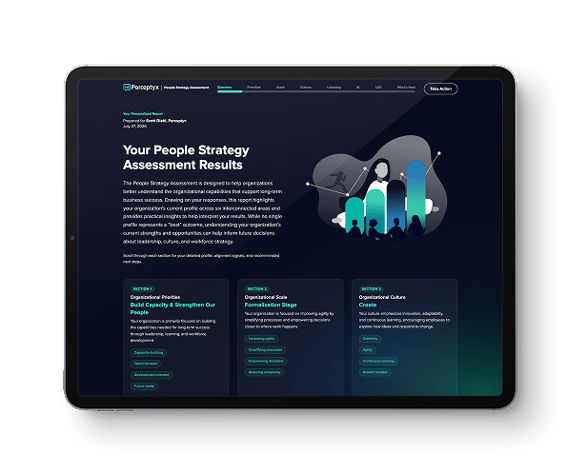
About the Authors

Zachary Warman, M.S., is a Senior Behavioral Scientist at Perceptyx. With a passion for leveraging data and research to improve workplace experiences, Zach brings extensive expertise in employee assessment and vocational interests. He earned his M.S. in Industrial-Organizational Psychology from The University of Texas at Arlington in 2017. Zach joined Perceptyx in 2024, where he continues to conduct impactful research, exploring the factors that shape employee engagement and organizational success. Prior to Perceptyx, Zach worked at Wonderlic, where he contributed to the development and enhancement of assessment products, designed feedback experiences for job applicants and employees, and conducted applied research on mobile assessment technology and device equivalence. His work has included conference presentations and published research on cognitive ability testing in mobile contexts.
Insights & Innovation

About Perceptyx
Perceptyx is the people activation company, closing the gap between understanding your workforce and actually developing it. By connecting employee listening, validated learning, and behavioral reinforcement into a single continuous system, Perceptyx enables organizations to move from insight to verified skill development, sustained behavior change, and measurable business performance. Powered by AI and one of the world’s richest employee experience datasets, Perceptyx helps leading enterprises build more adaptive, capable, and high-performing workforces.
For more information, or to speak with a member of our team, visit www.perceptyx.com
Stats Overview
-
600+ Global enterprise clients
-
1/3 Of the Fortune 100 use Perceptyx