The Infinity Loop
Building Workforce Capability Through Continuous Listening and Learning
Zachary Warman, M.S.
Senior Behavioral Scientist, Perceptyx
Executive Summary
Organizations today face constant pressure to develop new capabilities as business priorities, technologies, and workforce expectations continue to evolve. Although many organizations invest heavily in both employee listening and learning, these efforts often operate as separate initiatives. Employee feedback identifies workforce needs, learning programs build new skills, and measurement frequently ends when training is complete.
The organizations best positioned to adapt often take a different approach. They connect listening and learning into a continuous system that identifies capability needs, guides development investments, supports employees as they apply new skills, and measures whether those investments produce meaningful change. Rather than treating listening as a point in time activity, they use employee feedback throughout the learning process to continuously strengthen workforce capability.
Findings from a Perceptyx Workforce Panel suggest many organizations have begun moving in this direction. Nearly six in ten employees (59%) say their organization uses employee feedback to identify learning and development needs, while 68% agree learning addresses the skills they need to be successful. However, opportunities remain to strengthen this connection. Only 56% say their organization has a clear learning strategy, and only 59% agree learning programs are updated based on employee feedback, suggesting many organizations have not yet fully closed the loop between listening and learning.
This report introduces the Infinity Loop, a framework that positions employee listening and learning as parts of one continuous improvement cycle. By connecting employee feedback, learning investments, workplace application, and ongoing measurement, organizations can make more informed development decisions, strengthen workforce capability, and continuously adapt as employee and business needs evolve.
Key Findings
-
Listening is becoming part of learning strategy.
Nearly six in ten employees (59%) say their organization uses employee feedback to identify learning and development needs.
-
Learning is more often aligned than fully strategic.
Sixty-eight percent say learning addresses needed skills, compared with 56% who say their organization has a clear learning strategy.
-
Application depends on workplace support.
Sixty-eight percent say the work environment supports applying learning, while 65% say managers encourage the use of new skills.
-
The loop is not yet fully closed.
Although 65% say listening changes learning opportunities, only 59% say learning programs are updated based on employee feedback.
Listening Creates Direction
Organizations are investing more than ever in employee listening and learning. Listening programs continue to expand, providing organizations with richer insight into the employee experience, while learning investments help employees adapt to new technologies, changing roles, and evolving business priorities. Too often, however, these efforts operate independently, limiting their ability to create lasting organizational capability.
The organizations that adapt most effectively treat listening and learning as parts of the same continuous system. Employee feedback helps identify emerging capability needs, learning addresses those needs through targeted development, and ongoing listening determines whether those investments changed how employees work. Rather than viewing surveys as the end of the process, organizations should use workforce insights to guide learning, reinforce improvement, and inform future decisions.
Perceptyx’s State of Employee Listening research reinforces this distinction. Organizations with the strongest listening practices do more than collect employee feedback. They connect listening with action, integrate employee insights into coaching and development, and continuously use those insights to strengthen workforce capability.
Charles Newnam’s Beyond Course Completions white paper describes the same cycle from the operating side, as a closed loop of Discover, Activate, Develop, and Measure built so that an insight from one survey item triggers a specific intervention and then gets rechecked against that same item months later. This report examines that loop from the employee’s vantage point, using what employees report about whether their feedback changes what they learn.
Rather than viewing surveys as the end of the process, organizations should use workforce insights to guide learning, reinforce improvement, and inform future decisions.
Our Workforce Panel suggests many organizations have already begun making this shift. Nearly six in ten employees (59%) agree their organization uses employee feedback to identify learning and development needs. While encouraging, this also means that more than four in ten employees do not yet see feedback consistently shaping how their organization develops people.
The connection appears to extend beyond identifying development needs. Among employees who say their organization uses feedback in this way, 83% also say leaders model continuous learning, 82% believe their organization is actively helping employees build skills for future roles, and 81% say learning programs are updated based on employee feedback. Among employees who do not see feedback being used to identify development needs, favorability on each of these items is only 28%. These findings do not establish that listening alone produces a stronger learning culture, but they suggest that visible use of employee feedback is closely associated with broader organizational commitment to development.
The opportunity is not simply to collect more feedback or deliver more learning. It is to connect listening, development, application, and measurement into a continuous cycle that helps organizations build capability, adapt to changing business needs, and improve with every iteration.
From Separate Processes to a Continuous Capability System
High performing organizations create more value by connecting employee listening, learning, application, and measurement into one continuous system for developing workforce capability.
-
Traditional Approach
- Listen Survey employees
- Learn Deliver training
Process End
-
Continuous Capability System
1. Discover capability needs
2. Develop targeted learning
3. Apply new capabilities
4. Measure progress through listening
Process Repeats
Listening Reveals Capability Gaps
Only 56% of employees say their organization has a clear learning strategy for the next one to two years. Similarly, 61% believe learning programs are connected to business priorities, while 62% say their organization clearly communicates which skills will matter most in the future. Together, the results point to an opportunity for many organizations to create greater clarity around how learning supports future workforce capability.
These findings illustrate that feedback helps organizations identify more than broad development needs. It reveals where employees lack strategic direction, where learning investments may not appear connected to business priorities, and where future capability expectations remain unclear. Rather than assuming employees simply need more training, organizations can use these insights to determine where greater clarity, communication, or investment is needed.
Listening also uncovers practical barriers that influence whether employees can continue developing new capabilities. Only 58% of employees say they have enough time during work hours to participate in learning, suggesting that workforce capability depends not only on the quality of learning experiences, but also on whether employees can engage with them.
Not every capability challenge requires a new learning program. Sometimes the most valuable insight is recognizing that employees need greater alignment, clearer expectations, or stronger organizational support before additional learning investments can achieve their intended impact. Employee listening helps organizations distinguish between these different challenges, allowing leaders to make more informed decisions about where to invest.
Stats Overview
What Can Employee Feedback Reveal?
-
Employee listening helps organizations uncover different challenges that require different responses.
-
Strategic gaps:
Employees do not understand where capability development is headed. -
Alignment gaps:
Learning is not clearly connected to business priorities. -
Future readiness gaps:
Employees are unsure which skills will matter most. -
Environmental barriers:
Employees lack the time or support needed to continue developing. -
The goal is not simply to identify more learning opportunities. It is to identify the right opportunity to strengthen workforce capability.
Four Types of Capability Gaps
Employee listening helps organizations identify different types of capability gaps, from strategic alignment to practical barriers, so leaders can target the right solution instead of assuming every challenge requires more learning.
-
Strategic Gaps
1Future Skills2Learning Strategy -
Operational Gaps
3Business Alignment4Time to Learn
Seeing the Loop Through Different Lenses
Organizational roles provide different vantage points into how listening and learning operate. Executives and managers often have greater visibility into strategy, investment decisions, and organizational priorities, while individual contributors experience how those decisions translate into everyday development opportunities. Comparing these perspectives can help organizations identify where learning strategies are succeeding and where additional attention may be needed.
Across nearly every stage of the Infinity Loop, executives and managers report more favorable experiences than individual contributors. Executives and managers are substantially more likely to believe employee feedback identifies learning needs, learning addresses the right skills, listening results improve learning, and the work environment supports employees in applying new capabilities. Individual contributors report these experiences less consistently, suggesting that visibility into organizational intent does not always translate into the employee experience.
The pattern is especially notable because managers generally report experiences that are much closer to executives than to individual contributors. For example, 71% of executives and 68% of managers say employee feedback identifies learning needs, compared with 51% of individual contributors. Similarly, 71% of managers say learning programs are updated based on feedback, compared with 48% of individual contributors.
Using employee listening to compare the perspectives of executives, managers, and individual contributors can help organizations identify where learning strategies are succeeding and where additional attention may be needed.
A similar split can be found in our learning and development research. Beyond Course Completions reports perception of career opportunities at 77% among executives, 66% among managers, and 48% among individual contributors, with regular coaching from a manager at 80%, 66%, and 52%. That paper attributes the pattern to access rather than motivation, since senior leaders receive coaching and career context tied to their roles while individual contributors are more often pointed toward a course catalog.
Such differences do not necessarily indicate that one group is right and another is wrong. Leaders and managers may have greater visibility into the investments, processes, and decisions occurring behind the scenes, while individual contributors are better positioned to judge whether those efforts are consistently reaching employees. Employee listening makes these differences visible, allowing organizations to investigate where communication, access, reinforcement, or support may be breaking down.
The Infinity Loop is most effective when organizations evaluate learning from multiple perspectives. Looking beyond organization wide averages helps leaders understand whether learning investments are reaching employees as intended, where barriers remain, and where future resources can have the greatest impact.
Stats Overview
Why Compare Perspectives?
-
Employee listening creates value by helping organizations answer questions that completion rates and participation metrics cannot.
-
Do leaders and employees experience learning in the same way?
-
Are learning investments reaching the intended audience?
-
Which employee groups face different barriers?
-
Where should organizations investigate more deeply?
-
Understanding these differences helps organizations move beyond broad organizational averages and make more targeted decisions.
Different Experiences Across the Infinity Loop
Employee experiences become less favorable as organizations move from leadership perspectives to employees’ day-to-day experiences, highlighting opportunities to better understand how learning investments are experienced across the workforce.
Different Experiences Across the Infinity Loop
Legend
|
Feedback identifies learning needs
51%
68%
71%
|
|
Learning addresses needed skills
59%
77%
79%
|
|
Listening improves learning outcomes
56%
74%
77%
|
|
Learning updated from feedback
48%
71%
74%
|
|
Work environment supports application
61%
76%
79%
|
|
Learning improves performance
65%
78%
76%
|
|
Favorability
40% 50% 60% 70% 80% 90% 100% |
Turning Insight Into Better Investments
Employee feedback creates value only when it changes decisions. Once organizations understand where capability gaps exist, the next challenge is determining how to respond. The goal is not to create more learning opportunities. It is to invest in learning that addresses the capabilities employees need most while supporting the organization’s broader priorities.
Our Workforce Panel suggests many organizations are making this connection. More than two thirds of employees (68%) agree their organization provides learning that addresses the skills they need to be successful. At the same time, 64% agree learning reflects the real challenges they face in their work. Together, these findings suggest organizations are making progress in aligning development efforts with the realities of employees’ roles, while still leaving room to strengthen that connection.
Employee feedback should do more than identify problems. It should help organizations prioritize investments. Listening helps leaders determine which capabilities require attention, which employee groups need additional support, and whether existing learning continues to reflect changing business needs. Rather than relying on assumptions, organizations can use employee insight to guide where development resources will have the greatest impact.
As business priorities continue to evolve, learning strategies should evolve alongside them. Organizations that continuously connect employee feedback with development decisions are better positioned to build the capabilities they need today while preparing employees for the challenges ahead.
Stats Overview
-
68% of employees agree their organization provides learning that addresses the skills they need to be successful.
-
64% of employees agree learning reflects the real challenges they face in their work.
Using Employee Feedback to Guide Learning Investments
Employee listening helps organizations focus learning investments where they are most needed, rather than treating every capability challenge the same.
-
Employee Feedback
-
Identify capability priorities
-
Prioritize learning investments
-
Build workforce capability
Creating the Conditions for Growth
Even the most relevant learning experiences will have limited impact if employees cannot apply what they learn. Capability develops over time through practice, reinforcement, and opportunities to use new skills in meaningful ways. Organizations therefore need to think beyond learning itself and consider the workplace conditions that allow development to continue after formal learning has ended.
The Workforce Panel highlights three conditions that consistently support capability development. More than two-thirds of employees (68%) agree their work environment supports applying what they learn, while 65% say their manager encourages them to apply new skills following learning experiences. However, only 58% say they have enough time during work hours to participate in learning and development, suggesting that competing priorities continue to limit employees’ opportunities to grow.
These findings highlight that learning experiences introduce new capabilities, but the workplace determines whether those capabilities become part of how employees work every day. Managers reinforce new behaviors, teams create opportunities to practice, and organizations provide the time and support employees need to continue developing over time.
Employee listening helps organizations understand whether these conditions exist. Rather than assuming learning has been successful because employees completed a program, leaders can use employee feedback to identify barriers that prevent new capabilities from taking hold. Those insights make it possible to strengthen the work environment alongside future learning investments, creating a system where capability continues to grow long after formal development has ended.
Stats Overview
Learning Is Only One Part of the System
-
Capability grows when organizations create the conditions that allow employees to:
-
Practice new skills.
-
Receive reinforcement from managers.
-
Continue learning as work evolves.
-
Employee listening helps organizations understand whether those conditions are present and where additional support is needed.
Conditions That Support Applying Learning
Employees are most likely to build new capabilities when learning is reinforced by their work environment, their manager, and the time to continue developing.
Conditions That Support Applying Learning
Closing the Loop Through Continuous Improvement
Many organizations think of learning as a project with a clear beginning and end. Employees complete a course, attend a workshop, or finish a development program, and attention shifts to the next initiative. While participation metrics help organizations understand what was delivered, they provide only a partial picture of whether employees developed new capabilities or whether those capabilities are making a meaningful difference in their work.
Donald Kirkpatrick’s 1959 evaluation framework separated four levels of training outcome: reaction, learning, behavior, and results. Most organizations still report only on the first two. Beyond Course Completions argues that this reporting gap is why development budgets are difficult to defend, since completion data cannot tell a business leader whether anyone can now do something they could not do before.
The Infinity Loop extends beyond learning completion by making employee listening part of an ongoing cycle of improvement. Rather than assuming a learning investment achieved its intended outcome, organizations continue gathering employee feedback to understand whether employees developed the right capabilities, encountered barriers when applying new skills, and need additional support as business priorities evolve. Those insights help organizations strengthen future learning investments instead of simply repeating them.
Our Workforce Panel suggests many organizations are beginning to adopt this approach. Nearly two thirds of employees (65%) agree that employee listening results lead to meaningful improvements in learning opportunities, while 59% say learning programs are updated based on employee feedback. The relationship between these practices is substantial. Among employees who believe listening leads to meaningful changes, 79% also say learning programs are updated based on feedback. Among those who do not see listening producing meaningful change, only 24% say learning is updated in response to feedback.
Employees who see feedback shaping learning also report a stronger development system more broadly. They are 52 percentage points more favorable that learning connects clearly to career advancement, 49 points more favorable that learning keeps pace with changes in their roles, and 48 points more favorable that their organization has a clear learning strategy. These findings do not establish causation, but they suggest that visible responsiveness to employee feedback is closely associated with learning that feels more coherent, current, and connected to employees’ futures.
There is still room to strengthen this connection. Roughly four in ten employees do not yet experience learning evolving in response to their feedback. When employees cannot see how their input influences future development efforts, organizations miss opportunities to improve learning while also reducing the perceived value of participating in employee listening.
Continuous improvement is what distinguishes the Infinity Loop from a traditional learning cycle. Each round of employee feedback provides new insight into emerging capability needs, workplace barriers, and opportunities to strengthen future development efforts. Rather than treating listening and learning as separate initiatives, organizations create a system where every investment informs the next.
Stats Overview
Continuous Improvement Is Visible to Employees
-
Among employees who say listening leads to meaningful changes in learning opportunities:
-
79% also say learning programs are updated based on feedback.
-
Among those who do not see listening producing meaningful change:
-
Only 24% say learning programs are updated from feedback.
-
Visible responsiveness helps employees understand that listening is connected to action, not simply data collection.
When Feedback Shapes Learning, Employees See a Stronger System
Employees who see learning programs changing in response to feedback are substantially more likely to experience learning as strategic, current, and connected to their career growth.
When Feedback Shapes Learning, Employees See a Stronger System
Legend
| Item |
|---|
|
Learning connects to career advancement
85%
33% |
|
Learning keeps pace with changes in roles
85%
36% |
|
Organization has a clear learning strategy
75%
27% |
|
Percent Favorable
0% 25% 50% 75% 100% |
Building Organizations That Continuously Learn
Employee listening and learning are often treated as separate organizational priorities. One measures employee experience, while the other develops workforce capability. The findings in this report suggest these activities create the greatest value when they operate as parts of the same continuous system.
Employee listening helps organizations understand where capability gaps exist, which learning investments will have the greatest impact, and what conditions employees need to continue developing new skills. Just as importantly, listening helps organizations understand whether those investments are achieving their intended outcomes. By continuing to gather employee feedback after learning occurs, leaders can identify what is working, where barriers remain, and how future development efforts should evolve.
The Infinity Loop encourages organizations to move beyond viewing learning as a series of individual programs or listening as a collection of surveys. Instead, it positions both as ongoing processes that continuously inform one another. Each cycle provides new insight into workforce capability, allowing organizations to respond to changing business priorities while creating learning strategies that remain relevant over time.
Organizations that learn the fastest are not necessarily those that deliver the most training or collect the most feedback. They are the organizations that consistently connect employee insight with action, measure the impact of those actions, and use what they learn to make the next investment even stronger. In a workplace where change has become constant, that ability to continuously adapt may be one of the most important organizational capabilities of all.
Study Methodology
This report draws on findings from Perceptyx’s Infinity Loop Workforce Panel, conducted in July 2026. The study surveyed 2,992 employed individuals across North America and Europe representing executives, leaders, managers, and individual contributors across a broad range of industries. The analyses presented in this report draw primarily from a set of survey items examining the relationship between employee listening and learning, including how organizations identify capability needs, prioritize development investments, support employees in applying new skills, and use employee feedback to continuously improve learning. Unless otherwise noted, results presented throughout this report reflect the full sample. As with all cross-sectional survey research, findings describe relationships between variables and should not be interpreted as evidence of causation.
About the Authors

Zachary Warman, M.S., is a Senior Behavioral Scientist at Perceptyx. With a passion for leveraging data and research to improve workplace experiences, Zach brings extensive expertise in employee assessment and vocational interests. He earned his M.S. in Industrial-Organizational Psychology from The University of Texas at Arlington in 2017. Zach joined Perceptyx in 2024, where he continues to conduct impactful research, exploring the factors that shape employee engagement and organizational success. Prior to Perceptyx, Zach worked at Wonderlic, where he contributed to the development and enhancement of assessment products, designed feedback experiences for job applicants and employees, and conducted applied research on mobile assessment technology and device equivalence. His work has included conference presentations and published research on cognitive ability testing in mobile contexts.
Find Out Where Your Organization Sits in the Loop
After reading this report, find out where your organization stands. The Perceptyx People Strategy Assessment is a free diagnostic tool that profiles six areas: organizational priorities, scale, culture, listening maturity, AI maturity, and learning and development.
Get Started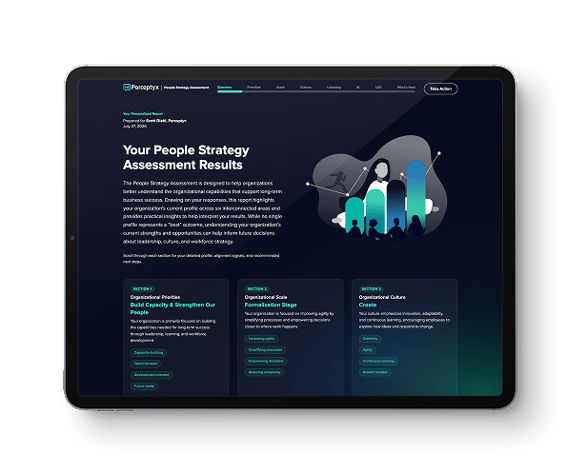

About Perceptyx
Perceptyx is the people activation company, closing the gap between understanding your workforce and actually developing it. By connecting employee listening, validated learning, and behavioral reinforcement into a single continuous system, Perceptyx enables organizations to move from insight to verified skill development, sustained behavior change, and measurable business performance. Powered by AI and one of the world’s richest employee experience datasets, Perceptyx helps leading enterprises build more adaptive, capable, and high-performing workforces.
For more information, or to speak with a member of our team, visit www.perceptyx.com
Stats Overview
-
600+ Global enterprise clients
-
1/3 Of the Fortune 100 use Perceptyx
-
13 Countries surveyed for this report
-
2,992 Employees surveyed in the Perceptyx research panel